


By Fresh Facts Magazine Editorial Desk
In an era where economic pressures, urban migration, and shifting social values are reshaping family structures across Africa, two men have drawn continental and global attention for building what many describe as some of the largest known families in modern African history.
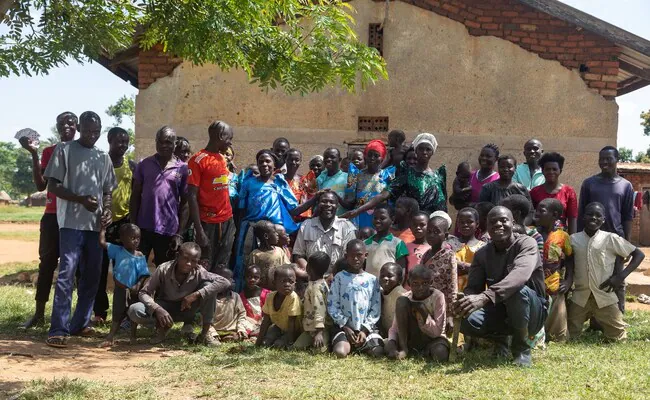
In eastern Uganda’s Bugisa region lives Musa Hasahya Kasera, a man widely reported to have fathered 102 children with 12 wives, and to be the patriarch of over 568 grandchildren. Hundreds of miles away in Tanzania, Mzee Ernesto Muino Pinga is similarly known for his 16 wives and more than 100 children, forming a sprawling lineage that stretches across generations.
Their stories are not merely about numbers. They are about culture, responsibility, changing realities, and the pressures of sustaining enormous households in a rapidly evolving Africa.
A Village Within a Village
In Bugisa, Uganda, Musa Hasahya Kasera’s compound functions like a self-contained community. With dozens of small houses arranged around a central space, the compound resembles a rural estate more than a traditional homestead. Children of varying ages fill the grounds — toddlers playing in the dust, teenagers tending crops, older offspring managing family affairs.
For decades, Kasera embraced polygamy as both a cultural and personal choice. In many parts of rural East Africa, large families historically symbolized wealth, influence, and security. Children were considered assets — strengthening agricultural productivity, ensuring lineage continuity, and providing social security in old age.
However, times have changed.
With inflation, rising food costs, school fees, healthcare expenses, and limited land resources, the cost of sustaining over 100 children has become staggering. Kasera has publicly acknowledged the economic weight of such a vast household, citing the practical need to stop expanding his family. Managing education, nutrition, and medical care for hundreds of dependents is no small feat.
“I have learned my lesson,” he reportedly stated in interviews, noting that the realities of modern life no longer support unchecked expansion.
Tanzania’s Patriarch of Proportion
Across the border in Tanzania, Ernesto Muino Pinga’s family narrative echoes similar themes, though shaped by different local dynamics.
With 16 wives and more than 100 children, Pinga’s household is organized with a structured hierarchy. Senior wives often play coordinating roles, ensuring food preparation, domestic order, and caregiving responsibilities are distributed efficiently.
In rural Tanzanian communities, polygamy remains legally recognized under certain customary and Islamic laws. Large families, especially in agricultural settings, have historically been considered practical — offering labor strength and clan continuity.
Yet even in Tanzania, demographic trends are shifting. Urbanization, female education, and economic restructuring are gradually reducing average family sizes. What was once the norm in many African societies is becoming increasingly rare in contemporary contexts.

Culture, Faith, and Responsibility
Polygamy and large family systems have long roots in African traditions. In pre-colonial societies, large households were often strategic — ensuring alliances between clans, expanding labor capacity, and strengthening social bonds.
But the modern African state — with formal education systems, monetized economies, and structured healthcare frameworks — presents new challenges. Raising over 100 children today involves school fees, transportation, clothing, vaccinations, and compliance with child welfare standards.
Family planning campaigns across East Africa have significantly reduced fertility rates over the past decades. Governments and NGOs promote maternal health, reproductive education, and sustainable household sizes as key development strategies.
Against this backdrop, families like those of Kasera and Pinga stand as cultural relics of an earlier era — yet still living, breathing realities.
The Economics of a Mega-Family
To understand the magnitude of raising such families, consider the basic costs:
- Feeding over 100 children daily
- Providing shelter and clothing
- Paying school tuition and examination fees
- Accessing healthcare services
- Managing land and inheritance distribution
The financial burden multiplies exponentially when grandchildren enter the picture. With 568 grandchildren in Kasera’s case, the extended lineage becomes a vast socio-economic network.
In rural settings, subsistence farming can sustain large households to a degree. But climate change, land fragmentation, and fluctuating agricultural yields have made traditional survival systems less reliable.
Social Impact on Women and Children
The women within these households shoulder significant responsibilities. In polygamous systems, co-wives often share domestic duties, yet emotional and economic pressures can intensify with scale.
Children, meanwhile, grow up in highly communal environments. While such structures can foster strong sibling bonds and collective identity, they may also dilute parental attention and strain access to education and health services.
Development experts argue that smaller family units often allow for deeper investment per child — improving educational attainment and upward mobility.
A Turning Point in Demographic Thinking
Africa remains the youngest continent in the world, with rapid population growth in several regions. However, fertility rates are gradually declining as literacy rises and urbanization expands.
The public acknowledgment by Musa Hasahya Kasera that he has halted further expansion reflects a broader continental shift. The prestige once attached to extremely large families is increasingly being weighed against economic sustainability.
Mzee Ernesto Muino Pinga’s household, too, exists in a changing environment where modern expectations intersect with traditional frameworks.

Between Legacy and Sustainability
The stories of these patriarchs provoke mixed reactions. For some, they symbolize cultural resilience and traditional pride. For others, they represent the urgent need for responsible family planning in a continent striving for economic transformation.
Yet beyond the debate lies a human story — of fathers attempting to manage vast legacies, of wives coordinating complex domestic systems, and of hundreds of children navigating identity within enormous kinship networks.
As Africa balances tradition with modernization, families like those in Bugisa and rural Tanzania serve as living case studies in demographic transition.
Their compounds may resemble villages today — but their future will be shaped by how well they adapt to the realities of tomorrow.
Fresh Facts Magazine Insight:
The era of monumental family sizes is gradually giving way to a model centered on sustainability, education, and economic viability. The question is no longer how many children one can have — but how well they can be raised.
And in that shift lies the future of Africa’s demographic destiny.


