


By Fresh Facts Magazine
Africa’s real estate sector is often described as “booming.” Towering estates rise across major cities. Luxury developments dominate skylines from Lagos to Nairobi. Investors speak confidently about growth and opportunity.
But according to My Ace-China — real estate success strategist and self-styled “Mayor of Housing” — what appears to be prosperity is actually a symptom of crisis.
“Real estate in Africa is not thriving,” he says. “It only looks like it is thriving because demand has swallowed supply.”
And behind the illusion lies a sobering reality: Africa faces an estimated 44 million housing deficit, with Nigeria alone accounting for between 17 and 28 million units.
Scarcity Disguised as Growth
In Nigeria, fewer than 500,000 housing units are delivered annually — far below what is required to close the deficit. At that pace, it would take decades to bridge the gap, assuming population growth stopped today. It has not.
Urban migration has intensified the crisis. Millions who own houses in their villages live as tenants or squatters in cities like Port Harcourt, Abuja, and Lagos, where economic opportunities are concentrated.
“Scarcity creates a pseudo-value,” Ace-China explains. “Developers seem successful because demand overwhelms supply before they even begin.”
What we are witnessing, he argues, is not an enabling environment but a state of emergency.
The Forex Barrier: When Housing Became Imported
Ace-China identifies foreign exchange dependency as the first and most critical barrier.
Between 80% and 90% of building materials used in Nigeria are imported — steel, roofing sheets, tiles, sanitary wares, glass, electrical fittings. When the naira depreciated from about ₦450/$1 to over ₦1,500/$1, construction costs effectively tripled.
A $100 material abroad becomes exponentially more expensive once import duties, transportation, and margins are added. In a country where minimum wage hovers around ₦70,000 (less than $50), affordability collapses.
“Forex has taken housing costs to nearly 300% of what they were,” he says. “And rent is rising not because landlords are greedy, but because houses are scarce.”

Industrial Parks and Indigenous Materials
His proposed solution is radical but practical: eliminate the forex barrier by producing building materials locally.
He calls for:
- Dedicated industrial parks for building materials.
- Duty-free manufacturing zones.
- Subsidized or free power for manufacturers.
- Mandatory local employment quotas of up to 80%.
With Nigeria’s gas reserves currently underutilized, he argues that flared gas could power such industrial clusters.
Beyond industrialization, he advocates a return to indigenous materials.
Seventy years ago, African communities-built homes from clay, bamboo, and straw — materials that were locally sourced and climate-responsive. Traditional houses were cooler and required no air conditioning.
“Bamboo has tensile strength comparable to steel,” he notes. “Burnt clay bricks provide better insulation than cement blocks. We abandoned sustainability for dependency.”
Modern Africa, he insists, must rediscover and industrialize what it already has.

Regulation, Corruption, and Building Collapse
Another urgent concern is Nigeria’s recurring building collapses.
Ace-China points to two primary causes: economic pressure that tempts developers to compromise quality, and regulatory failure rooted in corruption.
“Housing is the only industry where reducing quality is punished by collapse,” he says.
He distinguishes between genuine Public-Private Partnerships (PPP) and what he calls “Public-Political Partnerships,” where kickbacks reduce project quality before construction even begins.
Frequent demolitions, he argues, are equally damaging.
“Every demolished building discourages a hundred investors,” he says. “Investors don’t fight markets. They move to safer ones.”
Without regulatory credibility, diaspora capital — currently estimated at around $20 billion in remittances annually — will continue to flow into foreign property markets instead of domestic development.
Alessa Highlands: A Prototype for a New Africa
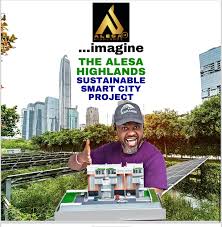
While his critique is sweeping, Ace-China is not content with theory. His flagship project, Alessa Highlands Sustainable Green Smart City in Rivers State, is designed as a proof of concept.
The development aims to redefine urban living through:
- Zero-emission energy systems.
- Electricity costs projected at 50% lower than conventional supply.
- No estate management fees.
- Low-density housing with expansive green spaces.
- Integrated horticulture for food, medicine, and landscaping.
- A major mall incorporating a traditional market structure with local-market pricing.
- A 10% CSR allocation of project expenditure dedicated to host community education, skills, and healthcare.
- 100% community-based artisan labor.
The vision is rooted in the original identity of Port Harcourt as the “Garden City” — a concept he hopes to restore.
“We are not rushing to scale,” he says. “We want to build one that proves what is possible.”
While Alessa Highlands targets high-end buyers, he confirms that a low-cost, resilient housing series is planned within the next 12 to 24 months.
Africa’s Greatest Asset: Its Youth
For Ace-China, housing reform is inseparable from demographic opportunity.
Over 60% of Africa’s population is under 30. Nigeria alone has one of the youngest populations in the world. He believes industrializing building materials and scaling housing could unlock massive employment potential.
“Our greatest energy is youth,” he says. “When you channel that energy into production and innovation, you solve housing and unemployment at the same time.”
An African Renaissance in the Making?
Recently nominated as an African Game Changer, Ace-China views recognition not as personal achievement but as a signal that Africa is beginning to celebrate its own builders.
However, he challenges institutions to go beyond awards.
“Africa does not lack talent,” he says. “We lack networking of value.”
His broader dream is continental collaboration — a unified ecosystem of African innovators working toward shared goals. If that unity emerges, he predicts that migration patterns could reverse within decades.
“The world will come to Africa,” he says confidently. “Not for aid, but for ideas and opportunity.”

Beyond the Mirage
The question remains whether policymakers will embrace the structural reforms he proposes — from industrial parks to regulatory overhaul.
But one thing is certain: the narrative that Africa’s housing sector is flourishing deserves closer scrutiny.
Behind the cranes and concrete lies a deeper story — one of scarcity, structural imbalance, and untapped potential.
And if My Ace-China has his way, the next chapter will not be about survival in scarcity, but about building prosperity from within.


