By Fresh Facts Magazine Staff Writer –
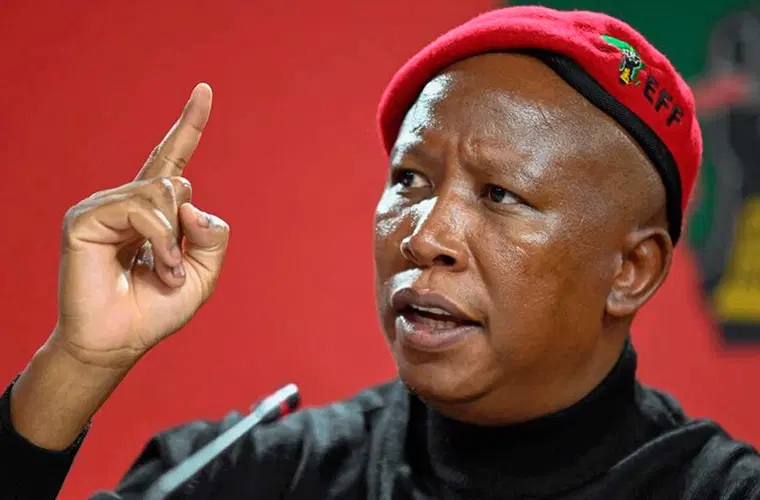
When South Africa’s fiery opposition leader, Julius Malema, took the stage at the Nigerian Bar Association’s (NBA) 2025 Annual General Conference in Enugu, the hall knew it was about to hear more than a polite speech. The Economic Freedom Fighters (EFF) leader is not known for diplomacy; he is known for fire. And once again, his words cut like a blade.
“Xenophobia is anti-African unity,” Malema thundered. “A Nigerian in Johannesburg or a Ghanaian in Cape Town is not a foreigner, but an African contributing to Africa’s progress. In the same way, South African entrepreneurs must be welcomed in Lagos as partners in a shared future.”
Malema’s words drew thunderous applause. They also touched a raw nerve. For years, relations between Nigerians and South Africans have been stained by xenophobic attacks in South Africa—sometimes fatal, often brutal, and always a painful contradiction of the Pan-African dream. By condemning xenophobia on Nigerian soil, Malema confronted the ghosts of South Africa’s contradictions and challenged his own people to rise above them.
A Call for Unity Beyond Borders
Delivering the keynote address on the theme “Stand Out, Stand Tall”, Malema painted a vision of Africa that is both bold and radical: one borderless continent with a single currency, a unified parliament, and one military command. To many, it sounded utopian. To Malema, it was survival.
“We are not a dark continent,” he declared. “How can we be dark when we have diamonds that shine among us?”
His vision was grounded in history. Malema reminded his Nigerian hosts of the sacrifices their country made during South Africa’s darkest days. From boycotting the 1976 Olympics and the 1979 Commonwealth Games, to students paying the so-called “Mandela Tax” from their salaries, Nigeria was at the forefront of the anti-apartheid struggle.
“When Mandela walked out of prison in 1990, one of his first stops was Nigeria—to say thank you. That solidarity cannot remain a relic of history; it must become the foundation of our economic collaboration today,” Malema urged.
Nigeria–South Africa: Twin Engines of African Growth
Malema argued that Africa’s destiny lies in the hands of its two biggest economies—Nigeria and South Africa. Yet, despite their immense natural wealth, both remain trapped in colonial economic structures where raw materials are shipped cheaply overseas, only to be re-imported as finished goods at “crazy prices.”
“The path forward is clear,” he said. “Nigeria and South Africa must industrialise together, build factories together, and process our resources on African soil. Imagine South African mining expertise combined with Nigerian oil wealth. Imagine Nigerian farms feeding the continent while South African technology drives logistics and machinery. That is the Africa we must build.”
He pointed to existing economic links—MTN, Shoprite, and Multichoice thriving in Nigeria, while Nigerian music, Nollywood films, and literature enrich South Africa’s cultural life. But, he warned, these gains are overshadowed by xenophobic violence, which he described as “a sickness born of poverty, inequality, and government failure.”
Debt, Dependency, and the New Struggle
In his signature style, Malema broadened his argument from xenophobia to the global stage. He warned African nations against the “debt trap” of loans from the IMF and World Bank.
“Our leaders commit future generations to debts they will not be here to pay when the colonisers come to collect,” he said.
To Malema, Africa’s unfinished liberation is not political but economic. His critique stretched from Lagos to Gaza, from Pretoria to Palestine. He condemned what he called the hypocrisy of international justice—quick to prosecute African leaders, but hesitant when Western powers or their allies commit atrocities.
“If the so-called international community is unwilling to deliver justice in real time, then Africa must advance its own courts, its own tribunals, its own instruments of solidarity,” Malema insisted, citing South Africa’s case at the International Court of Justice accusing Israel of genocide in Gaza.
Pan-Africanism in the 21st Century
Malema’s keynote was not just a speech; it was a manifesto for Pan-African revival. He reiterated the EFF’s radical vision of an Africa that reclaims its land, resources, and destiny from imperialist control.
“Our salvation will not come from Washington or Brussels,” he said, voice rising as if to echo across the continent. “It lies here, in Lagos and Johannesburg, in Abuja and Pretoria—in the hands of Africans who refuse to be divided.”
The lawyers, judges, and dignitaries in Enugu responded with rapt attention, applause, and at moments, visible unease. For Malema, discomfort is part of the message. Africa, he argued, cannot afford complacency in a world still tilted against it.
Fresh Facts Analysis
Julius Malema’s Enugu address was more than rhetoric—it was a reminder of the unfinished business of African liberation. His attack on xenophobia directly confronts one of South Africa’s most embarrassing internal crises, while his call for Nigeria–South Africa economic integration points to a realistic path toward continental transformation.
Whether Africa’s political leaders, trapped in short-term politics and personal interests, will heed his radical vision is another question. But Malema’s message to the NBA conference was unmistakable: unity, not division, is Africa’s only route to dignity, prosperity, and true independence.