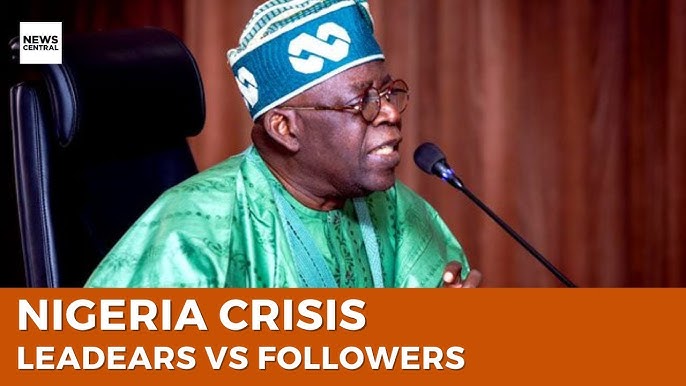
For decades, Nigerians have blamed the nation’s problems solely on leadership. Every administration is accused of corruption, insecurity, high cost of living, rising fuel prices, and lack of direction. Yet, after carefully observing Nigeria’s political history over the last fifty years, one begins to realize that the problem of Nigeria goes beyond leadership alone. It also lies in followership, national orientation, and the general character of Nigerians as a people.
A careful study of Nigeria’s history reveals a striking pattern. From the military coups of the 1970s to the democratic campaigns of today, the same complaints have remained constant. The coup speeches from 1976 onward repeatedly condemned insecurity, corruption, poor economy, high cost of living, fuel price increases, and clueless leadership. Decades later, political campaigns in the democratic era continue to revolve around these same issues.
When President Muhammadu Buhari campaigned against President Goodluck Jonathan, the major campaign points were corruption, insecurity, fuel prices, and economic hardship. Yet, barely two years into Buhari’s administration, Nigerians began to criticize him using exactly the same allegations that were previously used against Jonathan. Today, President Bola Ahmed Tinubu faces similar criticisms, while some Nigerians now openly claim that Buhari’s administration was better.
This trend is not new. Nigerians consistently believe that the immediate past government was better than the present one. During Buhari’s tenure, many criticized him harshly and demanded change. Today, many of those same individuals now speak nostalgically about his government, arguing that things were cheaper, security was better, and borrowing was lower. This pattern will most likely repeat itself after Tinubu’s tenure. Whoever succeeds him when God permits will face the same accusations within a short time, and many Nigerians will begin to praise Tinubu’s government in comparison.
This is not prophecy; it is simply the result of observing Nigeria’s political progression over time.
The uncomfortable truth is that Nigeria’s problem is not leadership alone. It is also followership and the collective attitude of Nigerians. Leadership exists at every level of society — in homes, communities, government institutions, schools, religious bodies, and security agencies. If leadership fails at these lower levels, the policies and intentions of the President may never materialize effectively.
Take the issue of insecurity as an example. Nigerian laws and security policies emphasize that security is everybody’s business. Citizens are encouraged to “see something and say something.” Communities are expected to cooperate with law enforcement agencies by providing useful information. Unfortunately, this culture is weak in Nigeria. Many people protect criminals either out of fear, ethnic loyalty, personal benefit, or distrust of security agencies.
In many communities, anybody who provides information to the police is mocked and stigmatized as a “police informant.” Such individuals are often isolated rather than celebrated for helping society. This negative orientation weakens law enforcement efforts and encourages criminality.
At the same time, many heads of security agencies do not maximize the resources available to them. Although security budgets may be insufficient, the outcomes are often not commensurate with the logistics and support already provided by government. The President cannot personally patrol communities or command every police operation. Effective security depends heavily on the commitment, competence, and sincerity of commanders and officers at lower levels.
Communities themselves also have responsibilities. Many communities are expected to organize vigilante groups, support them moderately, and contribute to their welfare to complement government efforts. Yet, many communities fail to do this effectively while placing all responsibility on the federal government alone.
Even on the issue of state police, which many believe could improve local security management, there are constitutional and political challenges. The current president desires state policing, but constitutional amendments require broad political support, including support from state governors and lawmakers. A President cannot simply impose such structural reforms unilaterally.
None of these arguments suggest that the President should not be held accountable. Certainly, Nigeria is experiencing serious hardship. Many Nigerians are hungry. Inflation is high. Fuel prices have increased. Insecurity remains a major challenge. The President carries enormous responsibility because the buck stops on his desk. However, governance cannot succeed without the cooperation, discipline, honesty, and patriotism of the people.
A society where corruption is admired, where criminals are protected, where public resources are looted at lower levels, and where citizens refuse to perform civic responsibilities cannot expect miraculous transformation from any President alone.
The truth is that many critics of government are not necessarily better alternatives. Some criticize government mainly because they are far from power. In Nigeria, the intensity of political criticism often depends on one’s distance from power and access to state benefits. Those benefiting from government frequently remain silent, while those excluded become the loudest critics.
This explains why many politicians who criticize corruption today were themselves accused of similar practices when they held public office. Political opposition is important in democracy, but Nigerians must also learn to examine the motives behind some criticisms.
The solution to Nigeria’s problems therefore requires more than changing Presidents. It requires changing national orientation, values, and attitudes. Nigerians must embrace honesty, accountability, patriotism, discipline, and responsibility at every level of society. Parents must raise responsible children. Community leaders must uphold justice. Religious leaders must preach integrity rather than materialism. Security agencies must act professionally. Citizens must support law enforcement genuinely.
Good governance begins from the bottom upward, not only from the top downward.
Until Nigerians collectively change their attitudes and sense of responsibility, the cycle of disappointment will continue. Governments will come and go, but the same complaints will remain. Leadership matters greatly, but followership matters just as much.
Nigeria’s transformation will only happen when both leaders and followers decide to change together. A situation where citizens fail to be good leaders in their family and work places but accuse the president of bad leadership will not transform Nigeria.
AIG David Igbodo RTD
President, Triple Justice Foundation.