By Fresh Facts Magazine — Special Investigation –
There are two Deltas of public conversation about Sen. Dr. Ifeanyi Arthur Okowa’s road legacy. On one side are campaign pages, government press notes and a string of ceremonies with ribbon-cutting photos that helped earn him the affectionate — and politically useful — sobriquet “Road Master.” On the other side is what residents, commuters and independent reporters see with their own eyes: collapsed sections, rising potholes, gridlock and a steady drumbeat of complaints about key arteries serving Asaba and its environs. Which of these two Deltas tells the truer story? The answer is neither simple nor flattering.
The official claim: quantity, pride and the headline number
Delta State and sympathetic outlets pointed to a big-picture tally during and after Okowa’s tenure — thousands of kilometres of roads and hundreds of kilometres of drainage completed as part of a visible road-building programme. State sources and agencies quoted cumulative figures (for example, 1,169 km of roads and 597 km of drainage in an eight-year period), and these figures were amplified by supporters and media as proof of transformation. Those numbers helped brand Okowa the “Road Master.”
The on-the-ground contradiction: Asaba’s failing arteries
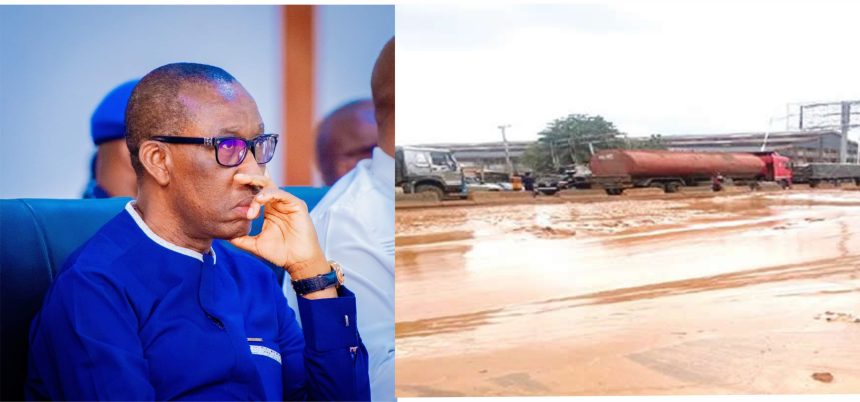
Walk — or drive — through Asaba today and you’ll find the contradictions. Major intercity connectors that serve the capital remain in very poor condition: the Asaba–Onitsha axis has seen collapsed sections, gridlock and at least one high-profile tanker accident that left commuters stranded; residents and commercial drivers have demanded urgent repairs. The Benin–Asaba corridor — a vital trunk linking Edo and Delta — has been repeatedly reported as riddled with potholes, flooding and long traffic snarls, prompting protests and local outcry. These are not isolated social-media rants; mainstream outlets and local investigations have documented repeated failures and slow remedial works on these same corridors.
What explains the gap between the headline and the lived experience?
The mismatch between the “kilometres built” narrative and collapsing pavements can be traced to a cluster of technical and governance problems that recur across Nigeria — and that local reporting shows are present in Delta:
- Design, materials and construction quality. Engineering reviews of Nigerian pavement failures identify poor geotechnical surveys, substandard materials and sloppy workmanship as persistent causes of early road failure. Roads that are resurfaced or built without adequate sub-base treatment or proper drainage will quickly develop cracks and potholes.
- Inadequate drainage and erosion control. Heavy seasonal rains in the South-South make drainage design critical. Where drainage is insufficient or blocked, water undermines pavement layers and shoulders, creating rapid deterioration — a common pattern reported on the Benin–Asaba and Asaba–Onitsha corridors.
- Maintenance vacuum. Building kilometres of road is not the same as owning a maintenance plan. Numerous studies and local reporting show that reactive patching, delayed routine maintenance and underfunded upkeep lead to rapid recurrence of defects. If maintenance budgets and institutions aren’t funded or empowered, newly completed roads decay quickly.
- Overloading and misuse. High-volume heavy trucks, tankers and overloaded trailers accelerate pavement fatigue; many roads in the Asaba corridor bear traffic they were never engineered for. Local reporters and transport analysts point to overloading and lack of enforcement as part of the problem.
- Contracting problems and abandoned works. Independent monitors and watchdog reports show that contractors sometimes abandon projects or perform substandard work even after payment; BudgIT/Tracka-style reporting has documented abandoned projects elsewhere, and local criticisms in Delta have flagged similar failures and stalled jobs. Government responses (e.g., insisting on warranties or querying contractors) acknowledge the problem but have not fully closed the loop.
The political economy: quantity vs. sustainability
Two practical realities help explain the “Road Master” image despite the collapse of some corridors:
- Counting surface length is easy; guaranteeing longevity is hard. Governments can award and commission many short or urban roads within an administration’s span and show ribbon-cutting photos. But lasting intercity highways — the ones that take the most abuse — require long-term design, stronger materials, drainage, and a maintenance fund and plan that survive political transitions. The optics of completed kilometres makes a strong headline; the less photogenic, continuous work of maintenance does not.
- Federal–state responsibility is messy. Some of the worst-affected corridors (Benin–Asaba expressway, Asaba–Onitsha) are federal or have mixed responsibilities, and delays at federal level, concession models, and coordination failures complicate accountability. The result: citizens see potholes and ask “who fixed it?” while politicians trade narratives. Recent reporting shows concession companies and federal actors involved in rehabilitation — but progress has been slow and visible pain remains.
Hard facts that puncture the slogan
- Supporters’ numbers: thousands of kilometres claimed built under Okowa’s watch.
- Visible failures: documented collapses, tanker incidents and commuter protests on the Asaba–Onitsha and Benin–Asaba corridors in 2024–2025
- Technical consensus: independent pavement studies attribute rapid failure to poor drainage, substandard materials, weak supervision and overloading.
Verdict — was it sycophancy, or bad governance?
The evidence suggests both. There was genuine road construction activity — visible projects, dozens or hundreds of kilometres — and those achievements mattered to communities. But counting kilometres and holding photo-op handshakes is not the same as building resilient highways. Where the projects were thin on engineering depth, maintenance funding, or supervisory rigor, the results have been short-lived. Political messaging amplified the successes; weak procurement oversight, contractor performance, drainage neglect and poor maintenance turned some successes into soon-to-be failures. That mix looks, in practice, like partial achievement wrapped in performance politics.
What needs to change — immediate and practical fixes
- Transparent forensic audits of problem road sections to identify whether design, materials, supervision or maintenance failed (and to hold contractors accountable).
- Ring-fenced maintenance fund for critical corridors rather than one-off patch budgets.
- Enforcement against overloading (weigh stations, sanctions) and regulation of heavy-duty traffic on routes not designed for it.
- Public publication of warranty and performance bonds (the five-year warranty policy is a step — make enforcement public).
- Independent project monitoring (civil-society/technical joint teams) and regular public condition reports so kilometres built are paired with kilometres certified as structurally sound.
Final line
“Road Master” as a brand was real — it was built from ribbon-cuttings, project tallies and visible urban resurfacing. But a brand is not the same as durable infrastructure. Asaba’s craters, collapsed sections and the commuter anger they have produced are a blunt reminder: transformation in public works must be measured in years of service, not in the photographs from a commissioning day. If Delta’s roads are to stop being a recurring headline of outrage, policymakers must shift from building monuments to building longevity.