


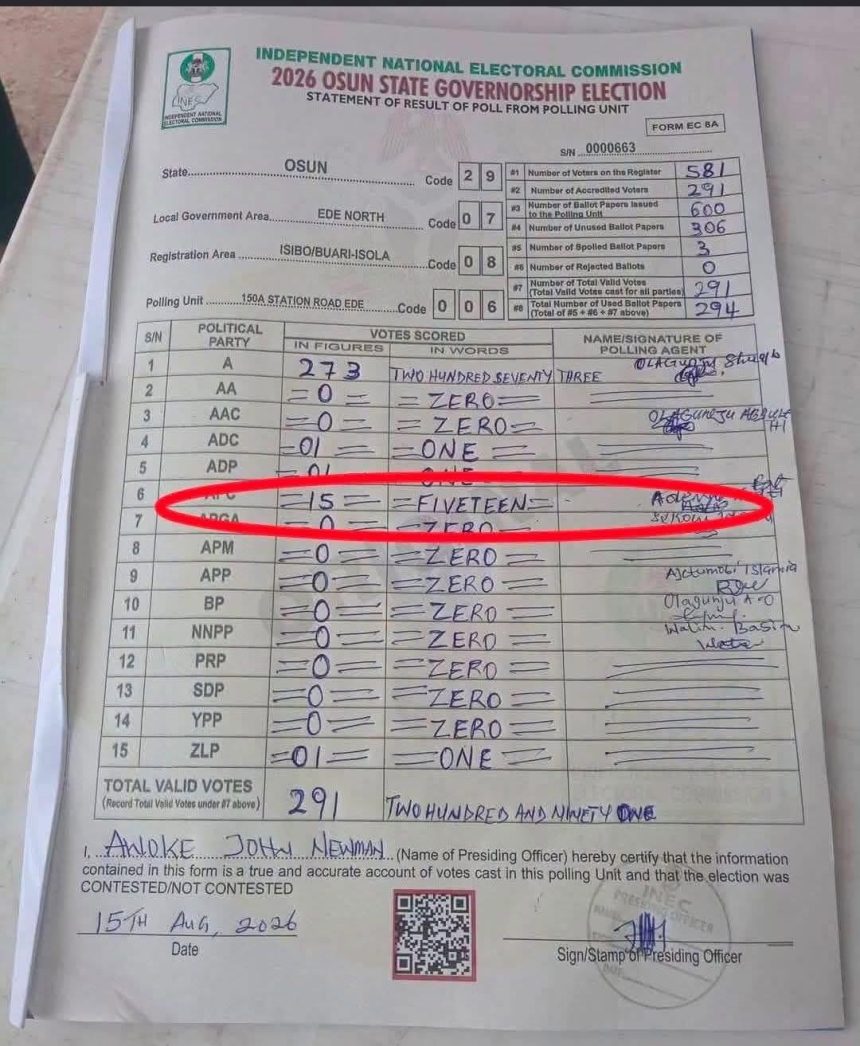
A spelling error reportedly found on a result sheet from the recently concluded Osun State governorship election has sparked debate over the quality of Nigeria’s education system, particularly after it emerged that the document was prepared by an electoral officer.
The controversy centres on the apparent spelling of the word “fifteen” as “FIVETEEN” on an election result sheet used during the exercise.
Although the error may appear minor, its presence on an official electoral document has generated concern among Nigerians, with many questioning the level of literacy, accuracy and attention to detail expected of officials entrusted with sensitive electoral responsibilities.
The issue, however, goes beyond the individual electoral officer or the particular result sheet.
For many observers, it raises broader questions about the relationship between Nigeria’s education system and the quality of personnel deployed to handle critical national assignments.
An electoral officer is expected to demonstrate a high level of accuracy, particularly when handling official documents containing figures, names, votes and other sensitive information. A seemingly simple spelling error may therefore become significant when it occurs within an official process where precision is essential.
It is important, however, not to use the incident to ridicule the individual involved. Human beings can make errors, including typographical and spelling mistakes. The larger concern is whether Nigeria’s educational system is adequately equipping people with the foundational literacy and professional skills required for positions of responsibility.
The incident has consequently reignited calls for a stronger emphasis on competence, literacy and practical learning rather than certificates alone.
Nigeria has invested heavily in formal education over the years, yet concerns persist over declining standards, inadequate resources, examination malpractice, teacher capacity and the growing gap between academic qualifications and practical competence.
The Osun election incident provides another opportunity for policymakers and education stakeholders to reflect on these challenges.
A university or higher-education certificate should represent more than the successful completion of examinations. It should ideally demonstrate a person’s ability to communicate effectively, apply knowledge, exercise sound judgement and pay close attention to detail.
In an electoral environment, these qualities become even more important because seemingly small mistakes can generate confusion, undermine public confidence or raise unnecessary questions about the integrity of the process.
The focus, therefore, should not simply be on the word “FIVETEEN.” The bigger question is whether Nigeria is producing graduates and professionals who possess the basic competencies required to perform effectively in positions of public responsibility.
As the country continues to strengthen its democratic institutions, there is an equally urgent need to strengthen the educational foundation upon which those institutions depend.
The Osun election result sheet may have contained just one apparent spelling error. But the conversation it has triggered is much bigger: Nigeria must begin to measure educational success not merely by the number of certificates awarded, but by the quality, competence and capacity of the people those certificates produce.


