Conference to examine professional standards, regulatory framework and the changing responsibilities of modern secretaries
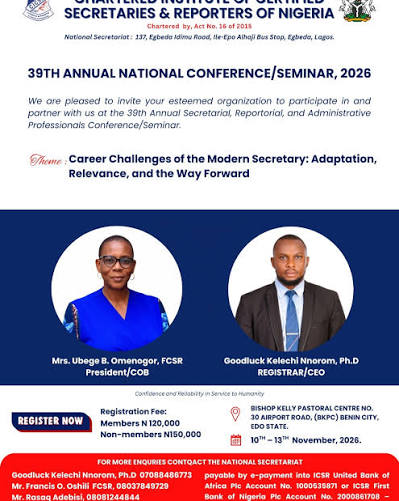
BENIN CITY, EDO STATE – The growing demand for professional standards, regulatory oversight and improved recognition of secretarial practice in Nigeria will take centre stage as the Chartered Institute of Certified Secretaries and Reporters of Nigeria (CICSRN) prepares to host its 39th Annual National Conference/Seminar in Benin City, Edo State.
The conference, scheduled for November 10–13, 2026, at Bishop Kelly Pastoral Centre, Airport Road, Benin City, is expected to bring together secretarial practitioners, administrative professionals, academics, policymakers and other stakeholders to deliberate on the future of the profession.
One of the major areas of discussion will be Regulation and Professionalisation of Secretarial Practice in Nigeria, an issue that has become increasingly important amid technological advancement, changing workplace expectations and the growing responsibilities of administrative professionals in public and private sector organisations.
The conference, organised under the broader theme, Career Challenges of the Modern Secretary: Adaptation, Relevance and the Way Forward, seeks to address the need for a more structured, competent and professionally recognised secretarial workforce.
According to the Institute’s conference announcement, other areas of focus will include digital transformation, career advancement, professional ethics, confidentiality, corporate governance, workplace resilience and the changing identity of the modern secretary.
The case for professional regulation
For decades, secretarial practice has played a critical role in Nigeria’s administrative and corporate environment. Secretaries and administrative professionals remain indispensable to effective communication, information management, records administration, executive coordination and institutional efficiency.
However, despite these responsibilities, the profession continues to face challenges relating to professional recognition, standardisation, career progression, capacity development and the distinction between trained professionals and individuals performing secretarial functions without adequate professional preparation.
The proposed discussion on regulation and professionalisation therefore raises fundamental questions about the standards required to practise, the qualifications and competencies expected of practitioners, ethical obligations and the institutional mechanisms necessary to protect the integrity of the profession.
A credible regulatory framework could help establish clearer professional standards, strengthen accountability, promote continuous learning and ensure that practitioners possess the competencies required in contemporary workplaces.
It could also improve public confidence in the profession and encourage employers to recognise secretarial practice as a specialised career rather than merely an entry-level administrative occupation.
Technology and the changing face of secretarial practice
The emergence of artificial intelligence, digital communication platforms, electronic records management and automated office systems has significantly transformed the traditional responsibilities of secretaries.
Today’s administrative professional is increasingly expected to possess competencies beyond typing, filing, correspondence and routine office duties.
Modern secretaries are required to understand digital information management, data protection, corporate communication, executive support, organisational coordination and aspects of institutional governance.
Consequently, professionalisation must go beyond the introduction of regulations. It must also embrace continuous professional development, technological competence, ethical conduct and the ability to adapt to changing organisational demands.
The conference provides an opportunity for stakeholders to examine how professional training and regulatory standards can prepare Nigerian secretaries for these emerging responsibilities.
Strengthening the profession through institutional recognition
The Chartered Institute of Certified Secretaries and Reporters of Nigeria, founded in 1981 and chartered under Act No. 16 of 2015, has a significant role to play in promoting professional standards, training and development within the secretarial and reportorial fields.
Its 39th Annual National Conference is therefore expected to provide a platform for constructive engagement on how the profession can achieve greater institutional recognition and remain relevant in an increasingly competitive labour market.
More importantly, discussions on regulation should consider the need to protect existing practitioners, provide accessible professional development opportunities and establish transparent pathways for certification and advancement.
Professionalisation should not become a mechanism for unnecessary exclusion but an instrument for raising standards, improving competence and creating equal opportunities for qualified practitioners.
A defining moment for administrative professionals
As preparations gather momentum for the Edo 2026 conference, stakeholders will be looking beyond the usual gathering of professionals to the practical recommendations and policy directions that may emerge from the deliberations.
The success of the conference should ultimately be measured not merely by attendance and presentations but by its capacity to stimulate reforms, strengthen professional institutions and improve the working conditions and recognition of secretarial practitioners across Nigeria.
For a profession that remains central to the effective functioning of government institutions, businesses and corporate organisations, the question of regulation and professionalisation is no longer one that can be ignored.
The 39th Annual National Conference/Seminar presents an important opportunity to confront these challenges and chart a sustainable future for secretarial practice in Nigeria.
EDO 2026: BENIN CITY, ALL THE WAY!