For decades, commuting in Enugu meant battling chaotic traffic, noise, and the notorious disorder of motor parks. Places like Holy Ghost, Gariki, Abakpa, and Nsukka were more than just transit hubs; they were synonymous with pickpockets, reckless drivers, and hawkers struggling for space with passengers. For many residents, stepping into these parks was a gamble with safety and sanity.
That reality is changing. On August 14, 2025, Governor Peter Mbah launched what is arguably the boldest transport reform in Enugu’s history. Five ultra-modern bus terminals were commissioned alongside the rollout of 100 Compressed Natural Gas (CNG) powered buses—part of a 200-bus fleet procured by the state. The initiative also unveiled the Enugu State Transport System and 80 newly constructed bus shelters.
What might look like infrastructure upgrades is, in fact, a calculated attempt to transform how Enugu moves—cleaner, safer, and smarter. The state is positioning itself as not just a regional hub but a national model for sustainable public transport.
From Chaos to Order: A New Commuting Experience
Until recently, the Holy Ghost motor park was a nightmare. Traders sprawled into the streets, vehicles parked haphazardly, and crime thrived in the shadows. Gariki was infamous for drug peddling and phone snatching. Commuters often described the experience as “organized lawlessness.”
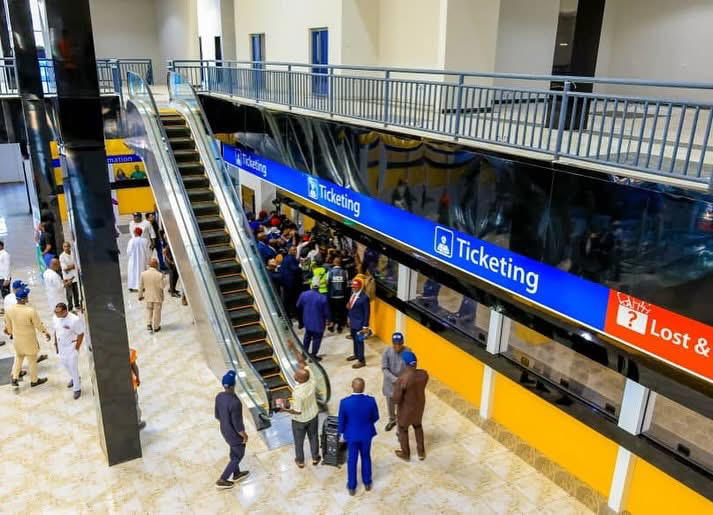
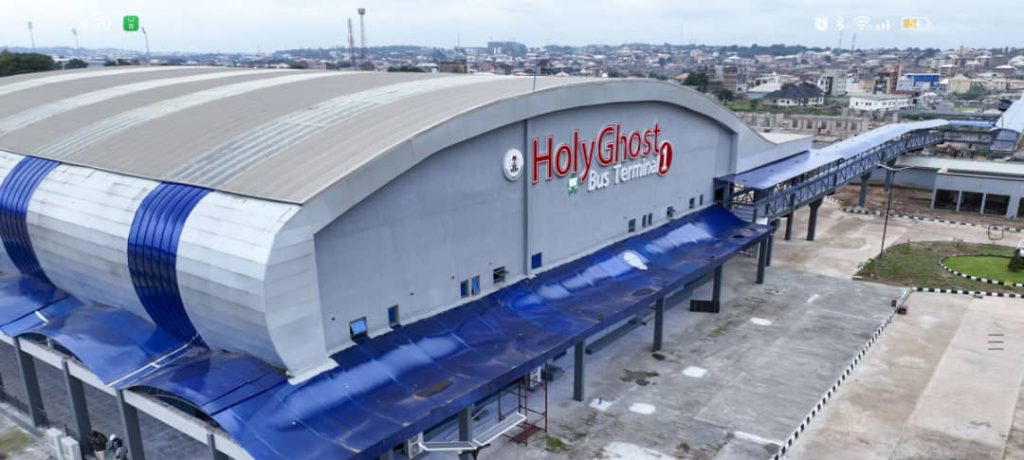
Today, that chaos is being replaced by order. The new terminals—Holy Ghost 1 (for inter-state routes), Holy Ghost 2 (for inter-city routes), Nsukka Central, Abakpa Central, and Gariki Central—offer a completely different experience.
They boast air-conditioned waiting halls, food courts, ticketing booths, clean restrooms, retail shops, cinemas, sit-out gardens, and even hotels. The Holy Ghost terminals are connected by Nigeria’s longest pedestrian skywalk—about 400 metres—designed to ensure smooth, safe movement across the bustling district.
At the launch, Governor Mbah noted that “Holy Ghost was practically a synonym for chaotic traffic and disorderliness.” Now, he says, “what we are witnessing is not just ribbon-cutting; it’s the start of a whole new commuter experience that restores dignity to millions of residents.”
For residents, the difference is striking. “Before, coming to Holy Ghost was like going to war,” says Ngozi Nnamani, a trader who commutes daily from Abakpa. “Now, I can sit in the waiting hall, drink water, and enter my bus without fear of my bag being snatched.”
Greener, Cheaper Mobility: The CNG Bus Revolution
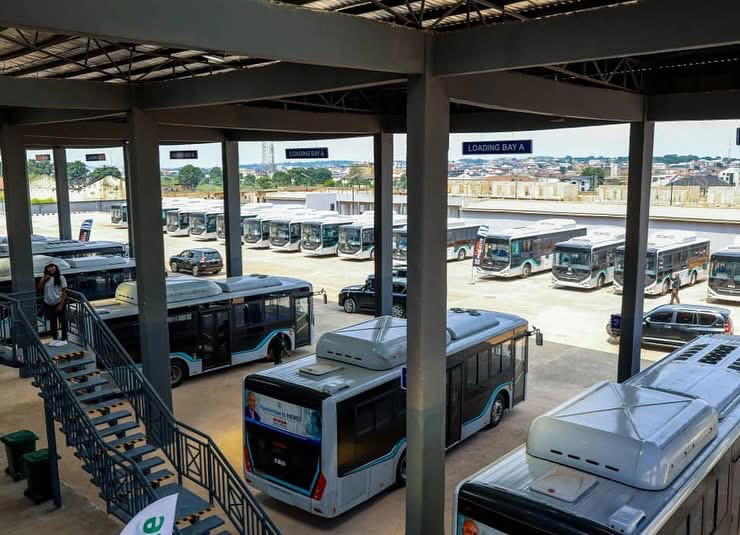
Equally central to the transformation is the new fleet of CNG-powered buses. These buses, beyond being eco-friendly, offer a cost-effective alternative to diesel and private vehicles. With Nigeria’s shift to cleaner energy after the removal of fuel subsidies, the timing could not be better.
Each bus comes with modern features—GPS tracking, electronic ticketing, passenger information displays, and CCTV surveillance. These not only enhance commuter safety but also ensure transparency in fare collection and real-time monitoring of fleet activities.
For many, the buses are more than machines—they are lifelines. Chukwuemeka Eze, a UNN student who travels from Nsukka, says: “Transport used to swallow half of my allowance. With these CNG buses, I save money and still travel in comfort. It makes student life less stressful.”
Even drivers are embracing the change. Ifeanyi Okoro, a former mini-bus operator now employed under the new system, admits: “At first we thought government wanted to take our jobs. But with the new buses, we have steady income, uniforms, and respect. I feel proud wearing my ID card.”
Jobs, Commerce, and Local Industry
Enugu’s transport reforms are not just about moving people; they are about moving the economy. The project is expected to create over 20,000 direct jobs in security, operations, maintenance, ticketing, and hospitality. Thousands more jobs are being generated indirectly through construction contracts, bus assembly, and technology services.
The partnership with Anambra Motor Manufacturing Company (ANAMMCO) ensures that many of the buses are being refurbished and produced locally, boosting skills transfer and industrial capacity.
Meanwhile, the terminals are attracting small businesses—eateries, banking halls, retail outlets, and logistics operators—turning them into mini commercial hubs and expanding the state’s revenue base.
At Holy Ghost 2, Amarachi Ofor, who runs a small food kiosk inside the new terminal, beams: “I used to sell akara outside in the dust and heat. Now, with this shop space, I have more customers and better sales. My children’s school fees are no longer a problem.”
Smart Transport: Digitizing the System
At the heart of the reform is a digital backbone. A unified transport platform now manages route planning, electronic ticketing, and fleet monitoring. Passengers can pay fares electronically, while government agencies track revenue in real-time—curbing leakages and enhancing efficiency.
This digital shift means commuters spend less time waiting, enjoy safer transactions, and can access live updates on travel schedules.
“I bought my ticket online yesterday and just scanned it at the terminal this morning,” says Samuel Ubah, a young tech worker. “That’s something I only saw in Lagos and Abuja before. Now Enugu is catching up fast.”
Linking Transport to Urban Growth
Transport is not just a service; it is an enabler of development. By transforming its transport landscape, Enugu is laying the groundwork for smart urban growth. Improved mobility encourages tourism, makes it easier for workers to reach jobs, and facilitates faster movement of goods.
Already, commercial investments are springing up around the terminals. Real estate developers, retailers, and logistics companies are eyeing opportunities in the renewed transport ecosystem.
Governor Mbah has stressed that this is only a phase in his broader urban regeneration agenda, which spans roads, housing, water, power, and digital infrastructure. With Enugu Air already launched, the vision is a multi-modal transport system integrating road, rail, air, and inland waterways.
A Model for Other States
Minister of Aviation Festus Keyamo recently praised Mbah as “a shining example of leadership that truly cares for the people.” Even President Bola Tinubu, who has supported key infrastructure projects in the state, has acknowledged Enugu’s rising profile.
What sets Enugu apart is not just the scale of investment but the integration of technology, sustainability, and human dignity into its transport vision.
For residents who once dreaded stepping into chaotic parks, the story has changed. Students, women, the elderly, and everyday workers now move with ease and safety.
As Mama Rose, a 65-year-old grandmother, put it while boarding a CNG bus at Gariki: “In my time, transport was suffering. Today, I feel respected as a passenger. Enugu is truly changing.”
In redefining public transport, Enugu is proving that mobility is more than moving people—it is moving society forward.