Union threatens industrial action as it demands full implementation of 2025 agreement
The Academic Staff Union of Universities (ASUU) has raised fresh concerns over the state of Nigeria’s university system, unpaid lecturers’ entitlements, inadequate funding of education, alleged victimisation of academics and the increasingly tense political atmosphere ahead of the 2027 general elections.
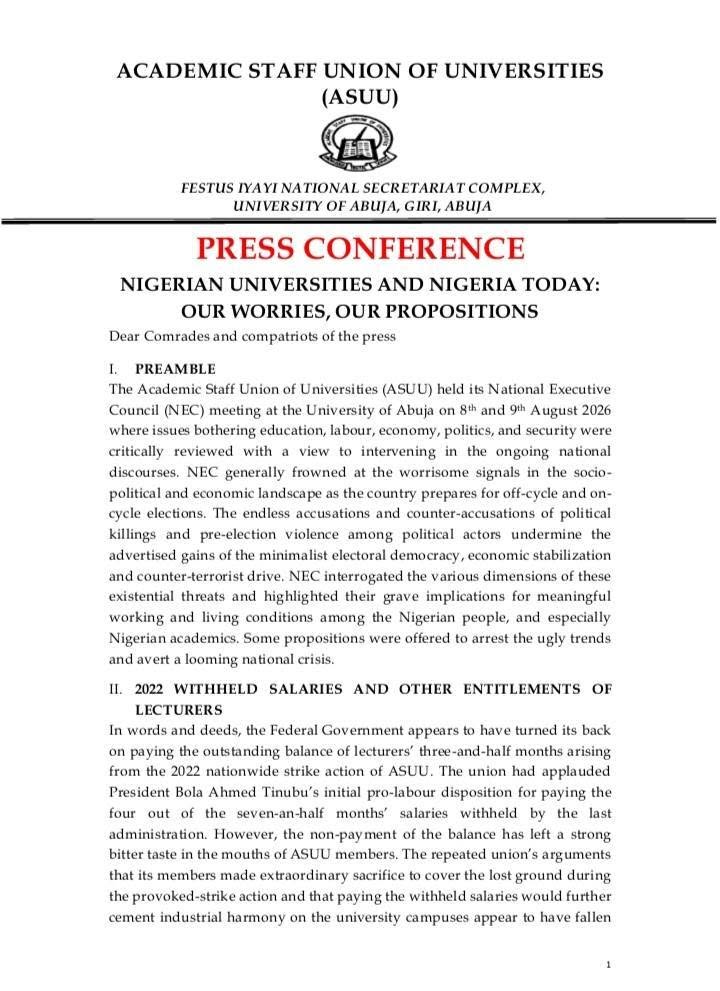
The union’s National Executive Council (NEC) made the observations at its meeting held at the University of Abuja on August 8 and 9, 2026, where it reviewed developments in education, labour, the economy, politics and national security.
At a press conference issued on August 13 and titled “Nigerian Universities and Nigeria Today: Our Worries, Our Propositions,” ASUU President, Christopher G. Piwuna, said the union was deeply concerned about developments capable of undermining industrial harmony in the nation’s universities and worsening the living conditions of Nigerians.
According to the union, the failure of governments to fully implement agreements reached with academic staff, combined with the rising cost of living and inadequate investment in critical sectors, could deepen social and economic tensions.
Three-and-a-half months’ withheld salaries remain unpaid
One of ASUU’s major concerns is the outstanding three-and-a-half months’ salaries withheld from university lecturers following the union’s 2022 nationwide strike.
The union acknowledged the payment of four of the seven-and-a-half months’ salaries withheld under the previous administration, describing the development as an indication of President Bola Ahmed Tinubu’s initial pro-labour disposition.
However, ASUU said the failure to pay the remaining three-and-a-half months had generated considerable resentment among its members.
The union argued that its members had made significant sacrifices during and after the 2022 industrial dispute, including working to recover lost academic time, and maintained that payment of the outstanding salaries would help strengthen industrial harmony in the university system.
ASUU said its repeated appeals on the matter appeared to have gone unheeded and warned that the situation could undermine the goodwill that followed the signing of the December 2025 FGN-ASUU Agreement.
The union also demanded the immediate payment of outstanding 25/35 per cent wage awards and promotion arrears, urging both the Federal Government and affected state governments to settle the obligations.
According to ASUU, the continued delay is testing the patience of academics across the country and could threaten industrial peace on university campuses.
2025 FGN-ASUU Agreement: implementation remains inadequate
The union also expressed disappointment over what it described as the haphazard implementation of the December 2025 FGN-ASUU Agreement.
ASUU said the agreement was expected to provide a framework for restoring stability and growth to Nigeria’s university system, but alleged that its implementation by both federal and state governments had been inadequate.
The union claimed that federal universities of agriculture had been largely excluded, while vice-chancellors of other federal universities were struggling to implement the financial provisions of the agreement because of inadequate funding.
At the state level, ASUU alleged that only about 10 per cent or fewer of state governors had openly endorsed the new salary package for academics, while others were allegedly shifting responsibility to university governing councils without providing the necessary financial resources.
The development, the union warned, could trigger renewed industrial action.
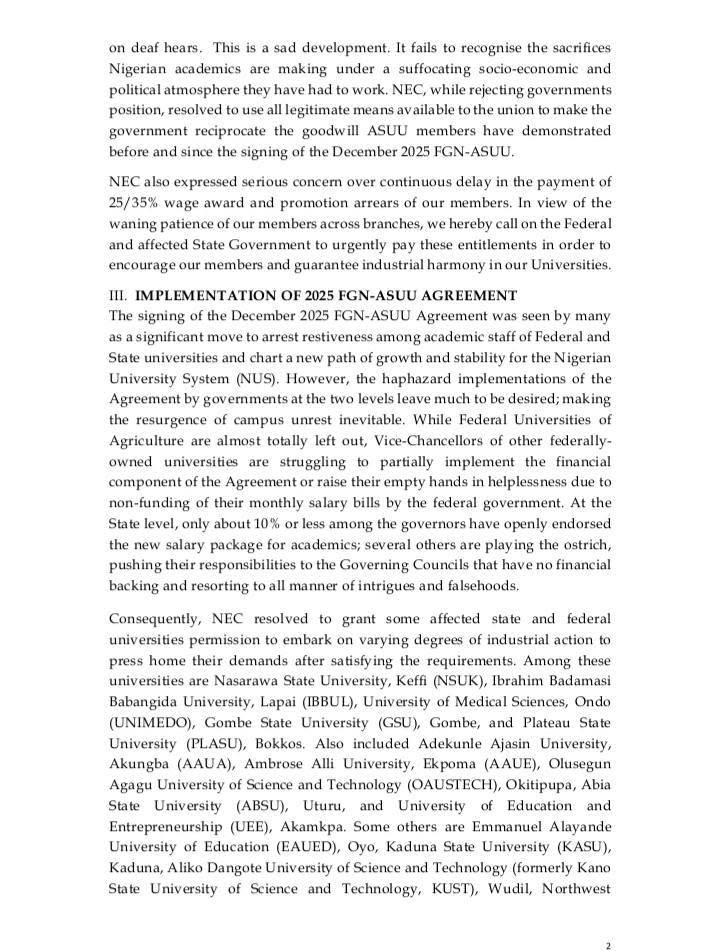
ASUU’s NEC consequently granted permission to a number of affected universities to embark on varying degrees of industrial action after fulfilling the required procedures.
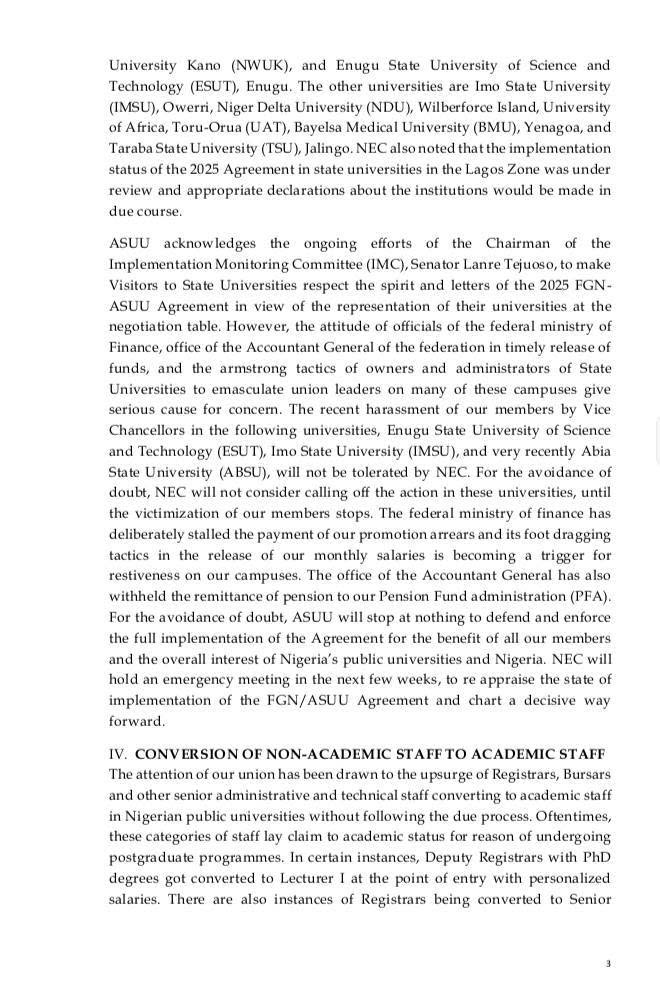
The institutions named by the union include Nasarawa State University, Ibrahim Badamasi Babangida University, University of Medical Sciences, Ondo, Gombe State University, Plateau State University, Adekunle Ajasin University, Ambrose Alli University, Olusegun Agagu University of Science and Technology, Abia State University, University of Education and Entrepreneurship, Emmanuel Alayande University of Education, Kaduna State University, Aliko Dangote University of Science and Technology, Northwest University Kano, Enugu State University of Science and Technology, Imo State University, Niger Delta University, University of Africa, Bayelsa Medical University and Taraba State University.
ASUU said the implementation status of the agreement in state universities within the Lagos Zone was still under review.
The union further accused some university authorities of victimising its members and said it would not support the suspension of industrial action in institutions where such alleged victimisation continues.
Universities specifically mentioned in this regard include Enugu State University of Science and Technology, Imo State University and Abia State University.
ASUU also raised concerns over the alleged withholding of pension remittances to Pension Fund Administrators and delays in the payment of promotion arrears.
The union said its NEC would convene an emergency meeting within the next few weeks to reassess the implementation of the FGN-ASUU Agreement and determine its next course of action.
ASUU rejects alleged “backdoor” conversion of administrators to lecturers
Another issue highlighted by the union is the alleged conversion of non-academic staff into academic positions without following established procedures.
ASUU said it had received reports of registrars, bursars and other senior administrative and technical staff being moved into academic positions, sometimes on the basis of postgraduate qualifications or questionable claims of teaching experience.
The union alleged that there had been instances in which senior administrative officers with PhDs were converted to Lecturer I positions with personalised salaries, while some registrars were allegedly elevated to senior academic positions on the basis of questionable publications and records of “proxy teaching.”
ASUU called on vice-chancellors and the National Universities Commission (NUC) to address what it described as an unacceptable development.
The union stressed that it was not opposed to legitimate career changes but insisted that anyone seeking to move from the non-academic to academic cadre should undergo a transparent selection process based on established criteria.
It also argued that vacancies should be properly advertised and that qualified internal and external candidates should be allowed to compete.
TETFund policy comes under fire
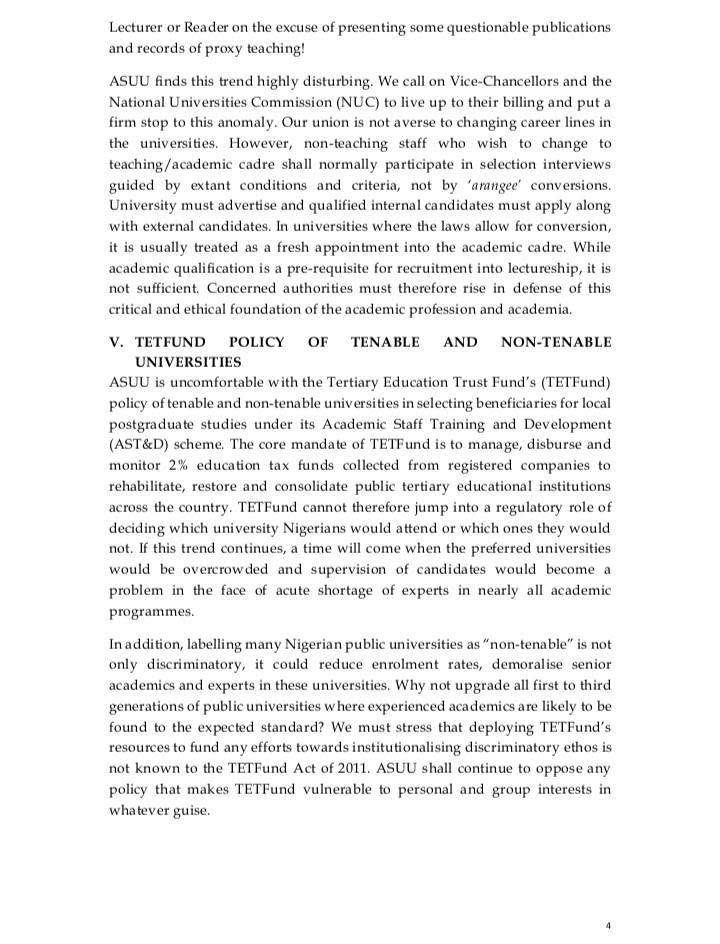
ASUU also criticised the Tertiary Education Trust Fund (TETFund) over its policy of categorising universities as “tenable” and “non-tenable” for the purpose of selecting beneficiaries under its Academic Staff Training and Development scheme.
The union argued that TETFund’s statutory responsibility is to manage and distribute the education tax fund for the rehabilitation, restoration and development of public tertiary institutions, rather than determine which universities Nigerians should attend or which institutions should benefit from postgraduate training.
ASUU warned that continued preference for certain institutions could lead to overcrowding in the favoured universities while depriving other public universities of qualified academics and development opportunities.
It further argued that labelling some universities “non-tenable” could discourage enrolment, demoralise academics and deepen inequalities within the university system.
The union therefore called for the upgrading of public universities rather than the institutionalisation of what it described as a discriminatory classification system.
ASUU sounds alarm over Nigeria’s political climate
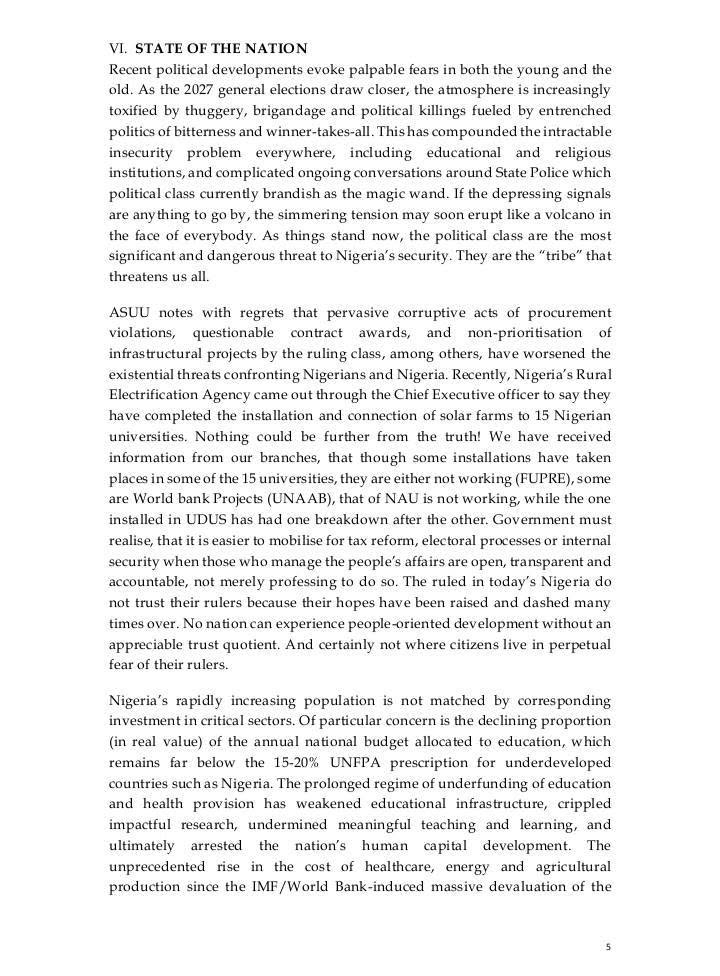
Beyond the university system, ASUU devoted a substantial part of its statement to the wider state of the nation.
The union expressed concern over what it described as increasing political tension ahead of the 2027 elections, alleging that thuggery, brigandage, political killings and winner-takes-all politics were contributing to the country’s worsening insecurity.
ASUU warned that the combination of political violence and existing insecurity could create an explosive situation if not urgently addressed.
In one of the strongest political observations contained in the statement, the union described the political class as a major threat to Nigeria’s security, arguing that the conduct of political actors was contributing significantly to the country’s instability.
The union also criticised alleged corruption in public procurement, questionable contract awards and the failure to prioritise critical infrastructure.
Questions REA claims on university solar projects
ASUU also challenged recent claims concerning the installation and connection of solar power projects in 15 Nigerian universities.
The Rural Electrification Agency had reportedly announced completion of the installations, but ASUU said information received from its university branches suggested that some of the projects were either non-functional, suffered repeated breakdowns or were projects funded through other arrangements.
The union cited the Federal University of Petroleum Resources, Effurun, Ahmadu Bello University and Usmanu Danfodiyo University among institutions where it said questions had arisen over the effectiveness or status of the installations.
ASUU called for greater transparency and accountability in public projects, arguing that government credibility is essential to securing citizens’ cooperation on tax reforms, elections and internal security.
Education and health funding remain major concerns
The union also warned that Nigeria’s rapidly growing population was not being matched by adequate investment in education, healthcare and other critical sectors.
ASUU particularly expressed concern over what it described as a declining proportion, in real terms, of the national budget devoted to education.
According to the union, prolonged underfunding has weakened educational infrastructure, constrained research, undermined effective teaching and learning and slowed the development of Nigeria’s human capital.
It also linked the rising cost of healthcare, energy and agricultural production to the broader economic difficulties confronting Nigerians, arguing that the depreciation of the naira had made basic necessities increasingly unaffordable to poor and marginalised citizens.
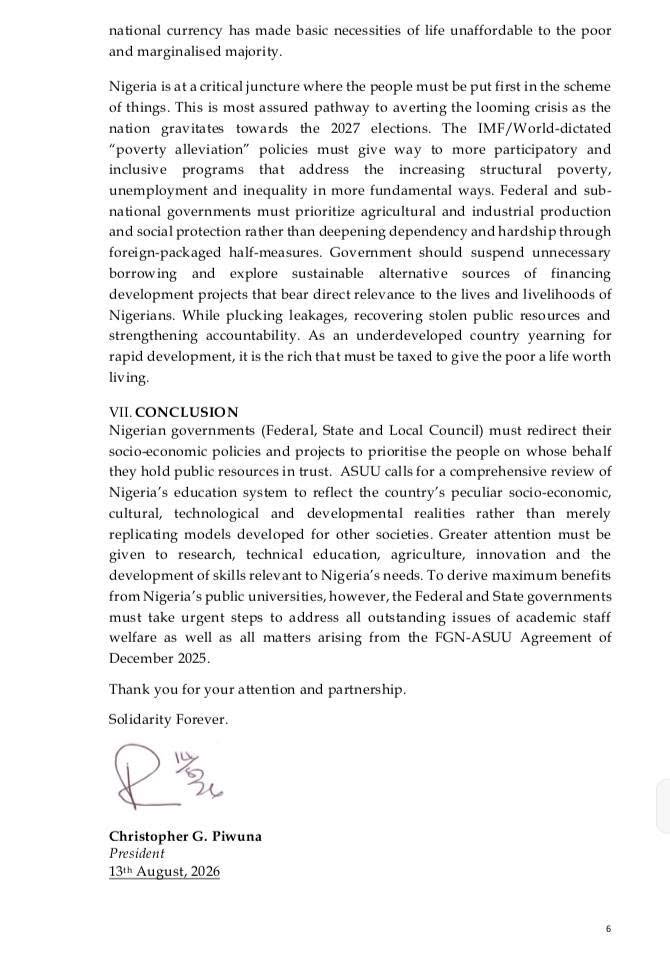
Union calls for people-centred economic policies
ASUU urged the Federal Government and sub-national governments to place the welfare of Nigerians at the centre of economic policy.
The union called for policies that address structural poverty, unemployment and inequality rather than measures it described as externally driven or inadequate.
It advocated increased investment in agriculture and industrial production, stronger social protection and sustainable financing of development projects.
ASUU also urged government to reduce unnecessary borrowing, recover allegedly stolen public resources, block leakages and strengthen accountability.
Its position was that Nigeria’s wealthier citizens should bear a greater tax burden in order to create a social and economic environment in which poor Nigerians can live with dignity.
ASUU demands comprehensive reform of university system
Concluding its statement, ASUU called on the Federal, state and local governments to redirect socio-economic policies towards the needs of the people.
The union advocated a comprehensive review of Nigeria’s education system to make it more responsive to the country’s social, economic, cultural, technological and developmental realities.
It called for greater emphasis on research, technical education, agriculture, innovation and skills development.
However, ASUU maintained that the full potential of Nigeria’s public universities could only be realised if governments urgently resolved outstanding issues relating to academic staff welfare and implemented all provisions of the December 2025 FGN-ASUU Agreement.
The statement, signed by ASUU President Christopher G. Piwuna and dated August 13, 2026, comes at a sensitive period for Nigeria’s university system, with unresolved labour issues, economic pressures and the political uncertainties surrounding the approach to the 2027 elections.
For the nation’s universities, the warning from ASUU is clear: without meaningful implementation of agreements, improved funding and stronger accountability, another cycle of industrial unrest may be difficult to avoid.