


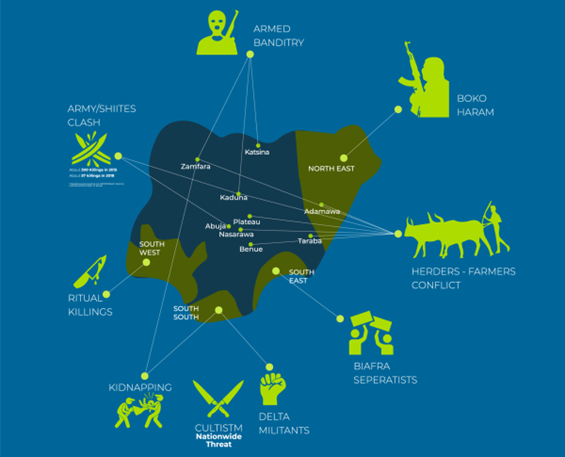
At a recent event for Senate members of Veritas University, Abuja, the Centre Director of the Psycho-Spiritual Institute, Rev. Fr. George Ehusani, sounded a chilling alarm: Nigerians are living in a state of national trauma.
“Nigeria is traumatised. Almost everyone is traumatised—from poverty to terrorist attacks, to banditry, insecurity, deaths, bereavement, losses, and all kinds of tragedies. And many people have no means or resources to process their trauma,” he declared.
Fr. Ehusani’s words mirror a grim reality underscored by disturbing statistics. According to the World Bank, 104 million Nigerians (47 per cent of the population) were living below the poverty line in 2023, up from 40 per cent in 2018. Insecurity has worsened: Nigeria’s Terrorism Index rose from 7.58 in 2023 to 7.66 in 2024, according to Trading Economics. The National Human Rights Commission (NHRC) reported that at least 2,266 people were killed by bandits or insurgents in just the first half of 2025, surpassing the total killings recorded in the whole of 2024.
The NHRC also documented a surge in rights violations, logging 275,256 complaints in May 2025 alone, a 5 per cent increase from the previous month. These included kidnappings, sexual and gender-based violence, violence against children, and attacks on law enforcement and religious leaders.
Such realities, many experts say, are reshaping the Nigerian psyche.
Living on the Edge
“Nigerians today are fractured people. Any slight push can trigger anger or irrational behaviour,” said social media marketer, Kelvin Imasuen, pointing to recent outbursts at airports as evidence of pent-up frustration. “Online, it’s even clearer. Share one negative experience, and you’ll find five others competing to share worse ordeals. That’s trauma bonding.”
Psychotherapist and cognitive behavioural specialist, Michael Jacob, agrees. He identifies mistrust of authority as one of the clearest signs of collective trauma in Nigeria.
“Decades of failed governance, broken promises, and state abuse have conditioned citizens to assume betrayal from institutions. Nigerians live in survival mode, constantly hyper-vigilant, fearing sudden violence, economic collapse, or destabilising policies,” Jacob explained.
This perpetual anxiety has, over time, normalised suffering. Expressions like “we go manage” have become more than cliches—they are survival mechanisms. For many families, this “scarcity mindset” is unconsciously passed down through generations, shaping anxieties, mistrust, and guardedness among children.
Jacob further notes that aggression in public spaces—road rage, heated arguments, quick tempers—are not always hostility, but trauma responses. The fear of state crackdowns, from the civil war to #EndSARS, has also fostered deep reluctance toward collective action, making Nigerians wary of protest or reform movements.
Interestingly, humour has become a coping tool. “Jokes and memes about corruption, fuel scarcity, and even tragedy serve as momentary relief, another sign of collective trauma,” Jacob added.
The Weight of History
Trauma in Nigeria, however, is not only contemporary. Dr. Toyin Ajao, Director of Ìmọ́lẹ̀ of Afrika Centre, traces it to intergenerational wounds—slavery, colonialism, tribalism, and systemic oppression.
“These inherited hurts influence how we relate, parent, lead, and dream,” Ajao said. “They manifest in family relations where duty outweighs love, schools that discipline instead of nurture, religions that shame instead of heal, punitive justice systems, and patriarchal dominance that values hierarchy over collaboration.”
She argues that Nigerians have normalised harm, creating cycles of internalised hatred, oppression, mental illness, and nervous system breakdowns. Citing the works of African scholars like Wangari Maathai, Sylvia Tamale, and Adewale Ajadi, Ajao stresses the need for a cultural shift—one that reclaims indigenous knowledge, Ubuntu leadership, and the integrity of Omoluwabi values as a foundation for healing.
Finding a Way Out
While the burden of trauma weighs heavily on the nation, mental health professionals insist recovery is possible. Psychotherapist Vincent Ehindero links Nigeria’s present struggles to its historical past—colonial exploitation, civil war, decades of military rule, and persistent governance failures. Yet, he maintains that recognising trauma is the first step toward collective healing.
Experts call for a multi-layered approach:
- Professional support systems that provide affordable access to counselling and therapy.
- Public education to normalise conversations around mental health and reduce stigma.
- Community healing frameworks rooted in indigenous traditions of reconciliation and collective care.
- Institutional reforms to rebuild trust and ensure accountability.
Ultimately, the road to recovery requires acknowledging that trauma is not just an individual burden but a national condition.
The Big Question
Nigeria, despite her resilience and humour, is bleeding internally. Citizens laugh at tragedy, distrust authority, lash out in public, and resign to fate—not because they are weak, but because they are wounded.
The haunting question remains: Can a traumatised nation truly heal without confronting its pain?


