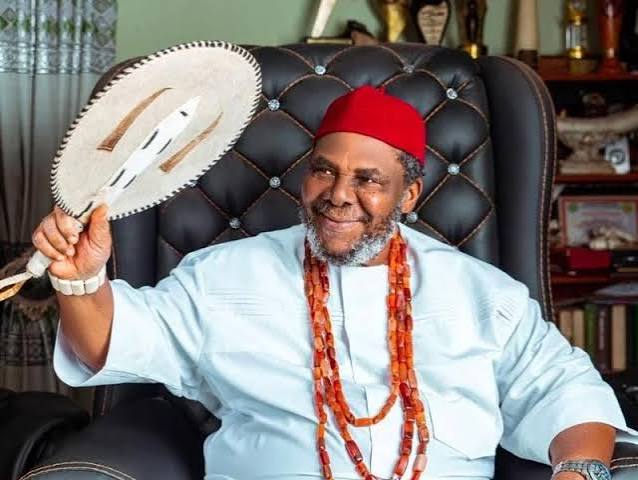
From the microphone of broadcasting to the throne of African cinema, the extraordinary journey of a man whose commanding voice, unforgettable performances, wisdom-laden expressions and cultural identity made him one of the most celebrated actors in the history of Nigerian entertainment.
There are departures that leave behind memories, and there are departures that create a void so profound that an entire generation struggles to find the appropriate words to describe the loss. The reported death of Chief Peter Uwadiegwu Ogugua Edochie, MON, popularly known as Pete Edochie, belongs to the latter category.
For millions of Nigerians and admirers of African cinema across the world, the news of his reported passing at the age of 79 is a rude shock, a painful reminder of the inevitable departure of even the greatest among mortals. It is the end of an extraordinary earthly journey that began in Zaria, Kaduna State, on March 7, 1947, and evolved into a remarkable story of talent, discipline, cultural preservation, professional excellence and enduring influence.
When the announcement emerged under the poignant title, An Iroko Has Fallen, the imagery was particularly appropriate. In African traditional symbolism, the iroko represents strength, longevity, dignity, authority and a presence that commands respect. Pete Edochie was, in many respects, the human embodiment of that symbolism.
He was not merely an actor who interpreted scripts. He was a storyteller who gave life to characters, a broadcaster who understood the power of communication, an ambassador of African cultural identity and an entertainer whose distinctive personality became inseparable from the evolution of Nigerian cinema.
His death, as announced by his family, marks the reported end of an era. But the legacy of a man whose performances have become part of Nigeria’s cultural memory cannot be buried with his remains.
Indeed, Pete Edochie may have taken his final bow on the stage of life, but the characters he created, the lessons embedded in his performances and the cultural heritage he projected will continue to speak to generations yet unborn.
THE BEGINNING: A BOY FROM ZARIA WITH ROOTS IN ANAMBRA
Born on March 7, 1947, in Zaria, present-day Kaduna State, Pete Edochie had his early beginnings in northern Nigeria, although his ancestral roots were firmly established in Akamnato, Ifite Nteje, Anambra State.
His upbringing exposed him to the richness of Nigerian cultural diversity and the traditional values that would later become defining features of his professional identity.
He attended St. Patrick’s and St. James Primary Schools in Zaria before proceeding to St. John’s College, Kaduna, for his secondary education.
His educational journey subsequently took him to England, where he studied journalism and television at the School of Journalism and Television.
Long before audiences became captivated by his commanding presence on television screens, Edochie was developing the communication skills, professional discipline and intellectual foundation that would distinguish his career.
His eventual choice of broadcasting was significant. It was through the microphone, rather than the movie camera, that he first established himself professionally.
FROM BROADCASTING TO NATIONAL RECOGNITION
In 1967, at a time when Nigeria was still finding its feet as an independent nation and its broadcasting industry was undergoing significant development, Pete Edochie began his professional career with the Eastern Nigerian Broadcasting Corporation.
He joined the organisation as a junior programmes assistant and gradually distinguished himself through dedication, competence and professional commitment.
His career in broadcasting was not a brief detour before acting. It was a substantial professional journey in its own right.
He rose through the ranks and eventually occupied important managerial positions at the Anambra Broadcasting Service, including Director of Programmes and Deputy Managing Director. He also served in an acting managerial capacity.
Those years gave him an understanding of programme development, audience engagement, public communication and the technical demands of broadcasting.
They also helped develop the extraordinary vocal control and delivery that would later become his trademark in acting.
His broadcasting background was particularly important because it equipped him with the ability to communicate authority, emotion, tension and persuasion without necessarily relying on exaggerated physical expressions.
He understood that sometimes the power of a message lies not in how loudly it is delivered but in the conviction, timing and depth with which it is communicated.
That understanding would eventually become one of his greatest assets on screen.
THINGS FALL APART: THE ROLE THAT CHANGED EVERYTHING
Every great actor has a defining moment, a performance that separates an accomplished professional from a national institution.
For Pete Edochie, that moment came in 1987 when he was selected to play Okonkwo in the Nigerian Television Authority’s television adaptation of Chinua Achebe’s internationally acclaimed literary masterpiece, Things Fall Apart.
It was a casting decision that would change the trajectory of his life and establish his place in the history of African entertainment.
Okonkwo was not an ordinary character. He was a complicated traditional warrior whose life was driven by ambition, fear, pride, cultural expectations and an overwhelming desire not to be perceived as weak.
He was respected in his community, celebrated for his strength and achievements, but equally troubled by the contradictions within his personality.
To portray such a character convincingly required more than memorising dialogue. It demanded an understanding of traditional African society, masculine identity, communal expectations, cultural conflict and the psychological tensions that shaped Okonkwo’s existence.
Pete Edochie delivered a performance that remains one of the most memorable in Nigerian television history.
He did not simply act as Okonkwo; he became the character in the consciousness of millions of viewers.
His physical presence, penetrating eyes, authoritative voice, measured movements and ability to communicate emotional conflict gave the character a remarkable degree of authenticity.
For many Nigerians who encountered Things Fall Apart through the television adaptation, Okonkwo became almost synonymous with Pete Edochie.
The production also introduced his talent to audiences beyond Nigeria, attracting international attention to his interpretation of the character.
The importance of this achievement cannot be overstated.
At a time when Nigerian film and television productions were yet to enjoy the international visibility that Nollywood commands today, Edochie demonstrated that African actors could interpret African literary works with sophistication, cultural authenticity and international appeal.
His portrayal helped bring Chinua Achebe’s fictional world vividly to life for television audiences and strengthened the relationship between Nigerian literature and screen storytelling.
It was a performance that would follow him throughout his career, becoming both a defining achievement and an enduring reference point for his artistic excellence.
THE BIRTH OF A NOLLYWOOD ICON
Following the success of Things Fall Apart, Pete Edochie became one of the most sought-after actors in Nigeria.
As the Nigerian film industry expanded, particularly through the home-video revolution of the 1990s, he emerged as one of its most recognisable and influential personalities.
The industry was developing a distinctive identity, creating opportunities for indigenous storytelling and bringing Nigerian productions into millions of homes.
Edochie became one of the faces of this transformation.
His performances were particularly effective in roles involving traditional rulers, wealthy patriarchs, influential businessmen, community leaders and men whose decisions shaped the destinies of families and communities.
His appearance alone could establish the atmosphere of a scene.
He possessed a rare ability to command attention without unnecessary theatrical exaggeration. A carefully delivered sentence, a prolonged silence or a stern facial expression could communicate more than several pages of dialogue.
Among his notable productions were Igodo, Rituals, Billionaire’s Club, Egg of Life and Lionheart, among numerous other films.
In Igodo, he demonstrated his ability to inhabit the world of traditional African storytelling, while in Billionaire’s Club and other contemporary productions, he showed that his talent extended beyond historical and traditional settings.
His appearance in Genevieve Nnaji’s 2018 film Lionheart further demonstrated his continuing relevance in an industry that had undergone significant changes in production standards, technology, audience expectations and international distribution.
What distinguished Edochie was his ability to remain recognisable across generations of filmmakers and movie audiences.
He was not an actor whose relevance depended entirely on the popularity of a particular era. His presence remained valuable because he represented a standard of performance that younger actors could study and appreciate.
THE VOICE THAT BECAME A NATIONAL TREASURE
One cannot tell the story of Pete Edochie without paying particular attention to his voice.
It was deep, authoritative, deliberate and unmistakably distinctive.
His voice was not merely an instrument for delivering dialogue; it was an essential part of his artistic identity.
In an industry where actors often compete for attention through dramatic gestures and emotional intensity, Edochie possessed the rare ability to dominate a scene through measured speech.
His delivery communicated experience, authority, confidence and sometimes menace.
When he spoke, audiences listened.
His frequent use of African proverbs also became a defining feature of his performances. He understood the cultural importance of proverbial expressions as vehicles for transmitting wisdom, correcting behaviour, exposing hypocrisy and interpreting the complexities of human relationships.
Through his characters, he introduced younger audiences to the richness of indigenous African expressions and the intellectual depth of traditional communication.
Many of his memorable lines became popular expressions in everyday conversations, social gatherings and eventually digital media.
His performances were repeatedly quoted, imitated and referenced by younger entertainers, comedians and social media content creators.
In an age when entertainment increasingly depends on short videos and rapidly changing trends, Pete Edochie’s voice and expressions remained remarkably relevant.
He became one of those rare personalities whose cultural influence extended beyond the original medium through which they achieved fame.
BEYOND THE KING’S PALACE: THE HUMAN BEING BEHIND THE CHARACTERS
For many years, audiences became accustomed to seeing Pete Edochie as a powerful chief, a traditional ruler, a wealthy patriarch or an uncompromising father.
His screen personality was so commanding that it sometimes overshadowed the man behind the characters.
Yet, beyond the royal robes, traditional titles and dramatic authority was a professional whose career had been shaped by years of discipline, broadcasting experience and commitment to his craft.
He understood the importance of preparation, delivery and professional conduct.
His transition from broadcasting to acting also demonstrated that artistic excellence does not necessarily begin with fame. It can emerge from years of consistent professional development and the willingness to embrace new opportunities.
He was a reminder that the entertainment industry needs more than popularity. It needs individuals who understand their responsibilities as custodians of culture and contributors to society.
Although he became particularly associated with patriarchal characters, his artistic contribution was much broader than the roles for which he was most frequently celebrated.
He helped demonstrate that Nigerian stories could command serious attention when interpreted by actors who understood the cultural, historical and emotional contexts of their characters.
FAMILY, MARRIAGE AND THE PRIVATE SIDE OF A PUBLIC FIGURE
Away from the cameras, Pete Edochie was a husband, father and family man.
He was married to Barrister Josephine Edochie, and their marriage was blessed with six children, including popular Nollywood actors Yul Edochie and Linc Edochie.
His family was an important part of his identity, even as his professional accomplishments made him a household name.
The emergence of Yul Edochie as an established actor created another connection between the Edochie family and the Nigerian entertainment industry.
The family’s affairs occasionally attracted public attention, particularly in recent years, but the broader story of Pete Edochie’s family life remains that of a man whose influence extended into another generation of entertainers.
His legacy is therefore not limited to the characters he portrayed or the awards he received. It also includes the family and professional heritage he leaves behind.
According to the family announcement, he is survived by his wife, children, siblings and other relatives.
For them, the loss is deeply personal. While the nation mourns a legendary actor, they mourn a husband, father, brother and family patriarch whose place in their lives cannot be replaced by public tributes or professional accolades.
HONOURS AND RECOGNITION: A CAREER THAT EARNED NATIONAL RESPECT
Pete Edochie’s contribution to Nigerian entertainment did not go unnoticed.
In 2003, the Federal Government of Nigeria, under former President Olusegun Obasanjo, recognised his contribution to the country by conferring on him the national honour of Member of the Order of the Niger (MON).
The honour was a significant acknowledgement of his professional achievements and his contribution to the cultural image of Nigeria.
He also received the Africa Magic Viewers’ Choice Awards (AMVCA) Industry Merit Award and a Lifetime Achievement Award from the Africa Film Academy.
In 2020, he was further recognised with the African Film Legend Award at the African Film Festival.
These honours represented more than individual accomplishments. They were acknowledgements of a career that had helped establish Nigerian acting as a respected professional discipline and a significant component of African cultural expression.
For an actor whose career began in broadcasting in 1967, the recognitions were a fitting testament to decades of commitment to his profession.
However, perhaps his greatest award was the affection and respect he commanded among ordinary Nigerians and audiences across Africa.
He belonged to that rare category of entertainers whose names could be mentioned in virtually any Nigerian household without requiring lengthy explanations.
PETE EDOCHIE AND THE PRESERVATION OF AFRICAN CULTURE
One of the most significant aspects of Pete Edochie’s contribution to entertainment was his role in projecting African identity.
At a time when foreign entertainment products were increasingly influencing popular culture, he consistently appeared in productions that celebrated African history, traditions, communal relationships and indigenous values.
His characters frequently embodied the traditional African understanding of leadership, family responsibility, authority, respect for elders and the consequences of human choices.
Through his performances, viewers encountered traditional institutions, indigenous expressions, cultural expectations and the complexities of African communal life.
He helped make traditional African storytelling attractive to younger audiences who might otherwise have viewed such narratives as belonging exclusively to an older generation.
His use of proverbs was particularly important in this regard.
African proverbs are repositories of history, wisdom, philosophy and communal experience. They are not simply decorative expressions but instruments through which generations communicate their understanding of life.
Edochie’s performances helped preserve and popularise this tradition.
He also demonstrated that African actors did not have to abandon their cultural identities to achieve professional excellence or international recognition.
His career was a powerful argument for the importance of telling African stories through African voices, perspectives and experiences.
THE MAN AND THE INDUSTRY: A LEGACY YOUNGER ACTORS MUST STUDY
The passing of a veteran actor of Pete Edochie’s stature inevitably raises important questions about the future of Nollywood and the preservation of its institutional memory.
The Nigerian film industry has grown tremendously, moving from the era of analogue television and home-video productions to digital filmmaking, international streaming platforms and global distribution networks.
Younger actors now enjoy opportunities that were largely unavailable to earlier generations.
However, technological advancement alone does not guarantee artistic excellence.
The industry needs discipline, professional development, originality, cultural understanding and a commitment to quality storytelling.
Pete Edochie’s career offers valuable lessons in these areas.
First, his journey demonstrates the importance of professional preparation. He did not emerge from nowhere. His years in broadcasting helped develop his communication skills and understanding of the performing arts.
Second, he demonstrated the importance of individuality. He did not need to imitate foreign actors or adopt artificial mannerisms to become internationally recognised. He developed a distinctive performance identity rooted in his own cultural environment.
Third, he showed that an actor’s influence can extend beyond entertainment. Through his interpretation of African characters, he helped preserve cultural expressions and introduced important literary and historical narratives to wider audiences.
Finally, his career demonstrated the value of longevity. He remained a recognisable and respected presence in the industry for decades, an achievement that deserves serious attention in an era increasingly dominated by fleeting celebrity.
For emerging actors, film producers, directors and screenwriters, his body of work should remain an important reference point.
THE REPORTED FINAL CHAPTER: A BATTLE WITH PROSTATE CANCER
According to the family announcement signed by his eldest son, Chief Leo Edochie, and titled An Iroko Has Fallen, the legendary actor reportedly died at 12:30 a.m. on Wednesday, November 25, 2026, in Enugu, after a prolonged battle with prostate cancer.
He was 79.
The announcement described him as a beloved husband, father, brother and kinsman, while identifying his professional accomplishments as a retired broadcaster and veteran actor.
The family also disclosed that funeral arrangements would be communicated in due course and appealed for prayers and support during the difficult period.
The reported circumstances of his death bring attention to the importance of health awareness, particularly among older men.
Prostate cancer remains an important public health concern, and the experiences of prominent individuals can help encourage conversations about early medical assessment, appropriate screening and access to healthcare.
Nevertheless, beyond the medical circumstances surrounding his reported departure, what deserves to be remembered is the extraordinary life he lived and the professional achievements he accumulated over nearly eight decades.
His final chapter should not diminish the remarkable story of his life.
THE EMPTY CHAIR IN NOLLYWOOD: CAN ANYONE REPLACE PETE EDOCHIE?
The entertainment industry will continue to produce talented actors. New stars will emerge, new films will capture public imagination and new personalities will command the attention of audiences.
But the question of whether anyone can replace Pete Edochie is more complicated than it appears.
Certainly, another actor can play a traditional ruler. Another performer can deliver proverbs, portray a wealthy patriarch or interpret a character with authority.
But replacing Pete Edochie means reproducing an entire artistic identity built over several decades.
It means possessing the distinctive voice, the measured delivery, the cultural understanding, the screen presence and the professional experience that made his performances immediately recognisable.
It means understanding that a great actor does not merely occupy a character’s position in a film; he must convince the audience that the character exists beyond the screen.
That was one of Edochie’s greatest strengths.
His performances were convincing because they drew from an understanding of human behaviour, traditional institutions and the complexities of African society.
There may be actors who will surpass his achievements in particular areas of filmmaking. That is the natural progression of every creative industry.
But there can never be another Pete Edochie in the exact sense of the man whose personal history, professional experiences and artistic personality combined to create a unique place in Nigerian cinema.
His departure therefore creates a vacuum that cannot be measured simply by the number of films he appeared in.
It is a cultural and institutional loss.
A LEGACY THAT WILL OUTLIVE THE MAN
The true measure of a great personality is not simply how widely he was celebrated while alive, but how much of his contribution remains relevant after his departure.
By that standard, Pete Edochie’s legacy is substantial.
His performance as Okonkwo in Things Fall Apart will remain a significant chapter in the history of African television.
His numerous Nollywood productions will continue to introduce his talent to new audiences.
His distinctive voice and memorable expressions will remain part of Nigeria’s popular culture.
His national honours will stand as official recognition of his contributions.
And his professional journey from broadcasting to acting will continue to inspire individuals who aspire to build lasting careers in the creative industry.
More importantly, he helped establish the idea that African culture is not an obstacle to international recognition. It is an asset that can enrich global storytelling when properly presented.
That may well be one of his greatest contributions.
He demonstrated that a Nigerian actor could interpret a character drawn from an African literary masterpiece and command the attention of audiences far beyond the shores of Nigeria.
He helped make the African traditional patriarch a familiar figure in Nigerian homes and became one of the most recognisable faces in the history of Nollywood.
CONCLUSION: THE IROKO MAY HAVE FALLEN, BUT ITS SHADOW REMAINS
There is something profoundly symbolic about the title chosen by the Edochie family for its announcement: An Iroko Has Fallen.
An iroko does not become insignificant because it has fallen. Its strength, age and contribution to the environment remain part of its story.
In the same way, Pete Edochie’s departure cannot erase the influence of a lifetime devoted to communication, entertainment and cultural representation.
He came into the world in Zaria, developed his professional identity through broadcasting, found national and international recognition through acting and eventually became one of the most respected personalities in African cinema.
He gave Nigerians an unforgettable Okonkwo. He gave Nollywood a commanding screen presence. He gave African storytelling a distinctive voice. And he gave generations of movie lovers characters and performances that will remain part of their collective memories.
The man may have taken his final bow, but the stories he told will continue to be heard.
The camera may no longer capture his performances, but the images he created will remain.
The voice may have fallen silent, but the wisdom, expressions and characters associated with it will continue to resonate.
For Fresh Facts Magazine, the story of Pete Edochie is not merely the story of an actor who achieved fame. It is the story of a Nigerian who transformed his talent into a national institution and used his profession to project the richness of African identity.
He was a broadcaster, an actor, a cultural ambassador, a husband, a father and, above all, a storyteller.
An iroko has fallen. But the forest will never forget the tree that stood so tall.
Rest in peace, Chief Peter Uwadiegwu Ogugua Edochie, MON.
March 7, 1947 – November 25, 2026.
A legend yesterday, a legend today, a legend forever.