LONDON, ENGLAND — The 2026 Ballon d’Or ceremony will be remembered as a landmark occasion in football history, not only for the players who emerged victorious but also for the controversies that threatened to overshadow the celebration. Held at the London Palladium on Monday, October 26, the 70th edition of football’s most coveted individual awards delivered historic milestones, emotional moments and a fresh round of arguments over what it truly means to be the best footballer in the world.
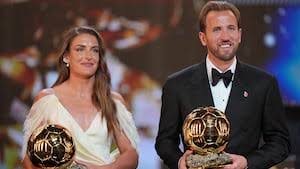
Harry Kane, the prolific Bayern Munich striker and England captain, finally reached the summit of individual football recognition, defeating France’s Kylian Mbappé and Spain’s teenage sensation Lamine Yamal to win the men’s prize. In the women’s category, Spain’s Alexia Putellas reclaimed the crown, securing her third Ballon d’Or Féminin after an outstanding season with Barcelona before her move to London City Lionesses.
However, while the winners celebrated, the wider football community was left debating the credibility of the voting process, the weight given to goals and team trophies, the treatment of competing candidates and the organisational shortcomings that disrupted the ceremony.
For an award celebrating its 70th anniversary, the event offered both a reminder of football’s extraordinary power to inspire and a warning that prestige alone cannot shield an institution from criticism.
Kane’s triumph: A victory built on consistency and productivity
Harry Kane’s victory was arguably the most compelling personal story of the evening. At 33, the England captain became the first Englishman since Michael Owen in 2001 to win the men’s Ballon d’Or, ending a 25-year wait for an English recipient.
His achievement was founded on exceptional productivity. Kane scored 61 goals in 51 appearances for Bayern Munich across competitions and finished the campaign with 73 goals for club and country. He helped Bayern secure a domestic league and cup double, while his performances in the UEFA Champions League and the 2026 World Cup strengthened his credentials.
Kane also scored six goals at the World Cup, where England reached the semi-finals. His combination of clinical finishing, intelligent movement, passing ability and leadership made him more than a conventional penalty-box striker.
For years, Kane’s career had been defined by personal brilliance accompanied by the disappointment of falling short of major honours. His departure from Tottenham Hotspur for Bayern in 2023 changed the trajectory of his career, bringing him into a team environment where trophies became a more regular feature of his professional life.
His Ballon d’Or triumph therefore represents more than a reward for a prolific season. It is a recognition of perseverance, consistency and the ability to remain productive at the highest level over an extended period.
Yet, even a victory supported by impressive statistics does not automatically end the debate over whether the winner was the most deserving candidate.
Was Kane unquestionably the best player of the year?
The central question surrounding the 2026 award is not whether Kane enjoyed an exceptional season. The evidence strongly supports that conclusion. The more difficult question is whether his individual achievements placed him above every other contender when all relevant factors are considered.
The Ballon d’Or is an individual award, but football is a collective sport. A striker’s output depends partly on the quality of his teammates, tactical arrangements, service from midfield and the overall strength of his club. Similarly, a midfielder’s influence or a defender’s contribution may be difficult to capture through goals and assists alone.
Kane’s 73-goal tally is extraordinary, but statistics must be interpreted in context. Goals demonstrate productivity; they do not, by themselves, measure every dimension of performance. Chance creation, tactical influence, pressing, defensive contribution, performances against elite opponents and decisive interventions in crucial matches all deserve consideration.
This is where the debate becomes more complicated.
Mbappé finished second, while Yamal occupied third place. Both had compelling cases of their own, and the final ranking reflected the difficult task facing voters in a season packed with outstanding individual and collective performances.
The fact that Kane won does not mean his rivals had poor campaigns. Rather, it demonstrates that the award requires voters to compare players whose contributions differ significantly according to position, responsibility and tactical role.
A more transparent public explanation of how the competing achievements were assessed would help supporters understand why one outstanding season ultimately prevailed over another.
Mbappé and Yamal: The frustration of coming second and third
For Kylian Mbappé, second place was another reminder of how difficult it can be to convert extraordinary individual performances into football’s highest individual recognition.
The French forward remains one of the most dangerous attacking players in world football, combining pace, movement, technical ability and an exceptional capacity to decide matches. His supporters can reasonably argue that his influence and goal-scoring achievements merited serious consideration for the award.
Nevertheless, the Ballon d’Or is not decided exclusively by reputation or individual brilliance. The broader context of a player’s season, including team achievements and performances across competitions, inevitably influences voters.
Mbappé’s second-place finish should therefore be interpreted as recognition of an outstanding campaign rather than proof that he was necessarily the victim of an injustice.
Yamal’s third-place finish was equally significant. At such a young age, the Barcelona and Spain star has already established himself among the leading figures in world football. His creativity, confidence, close control and ability to challenge experienced defenders make him one of the sport’s most exciting emerging talents.
He also won the Men’s Young Talent of the Year award for the third consecutive time, confirming his continued prominence among football’s next generation.
However, the tendency to measure young players against the achievements of established superstars can create unrealistic expectations. Yamal’s development should be judged by his consistency, decision-making, tactical maturity and continued improvement, rather than by whether he wins every major individual award before reaching his prime.
His third-place finish is an achievement in its own right. It also leaves him with a clear incentive to continue developing into a player capable of dominating the sport for years to come.
The debate over big-game performances
One of the most contentious arguments following Kane’s victory concerned the relationship between statistical output and performances in decisive matches.
Former Manchester City and France midfielder Samir Nasri questioned whether Kane consistently made the difference in the biggest games, despite acknowledging the striker’s extraordinary qualities. His criticism illustrates a wider disagreement over how the Ballon d’Or should assess individual excellence.
There is a legitimate argument that performances in the most demanding matches deserve considerable weight. A player who scores consistently against elite opposition, delivers in knockout competitions and changes the outcome of major encounters can make a particularly strong case for individual recognition.
However, big-game influence should not become an excuse to dismiss the value of sustained excellence over an entire season.
A football campaign consists of far more than a handful of high-profile fixtures. League matches, cup competitions, European encounters and international commitments all contribute to a player’s overall record. Consistently delivering across those demands is itself a form of greatness.
The fairest approach would assess both sustained productivity and decisive influence, rather than treating them as competing definitions of excellence.
Kane’s season deserves to be judged against that balanced standard. His goal tally, contribution to Bayern’s domestic success and performances for England offer substantial evidence in his favour. Questions about his influence in particular matches can form part of the discussion without automatically invalidating his achievement.
Putellas reclaims the women’s crown
While the men’s award attracted considerable attention, Alexia Putellas’ victory provided one of the night’s most compelling stories.
The Spanish midfielder secured her third Ballon d’Or Féminin after helping Barcelona win a domestic treble and the Spanish Super Cup during the 2025–26 campaign. She subsequently moved to Women’s Super League side London City Lionesses in July 2026.
Her victory placed her level with former Barcelona teammate Aitana Bonmatí, who had dominated the women’s award in the preceding three years.
Putellas’ achievement was especially meaningful given her recovery from a serious anterior cruciate ligament injury sustained in 2022. Her return to elite performance demonstrated the resilience, patience and determination required to rebuild a career after a major setback.
Her message at the ceremony was particularly powerful: aspiring footballers should pursue their dreams regardless of gender or background.
The award also underscored the increasing stature of women’s football, where technical quality, tactical sophistication, athletic performance and commercial visibility have continued to develop.
Nevertheless, the women’s game still deserves greater investment, wider media exposure, stronger grassroots structures and more equitable opportunities. Individual awards can celebrate exceptional players, but lasting progress requires sustained institutional commitment.
Putellas’ victory should therefore be seen both as personal recognition and as an opportunity to renew attention to the development of women’s football worldwide.
A ceremony that undermined its own prestige
For all the sporting achievements, the organisation of the 2026 ceremony generated its own controversy.
The event was delayed by approximately 45 minutes amid transport and arrival difficulties in London. More seriously, prepared articles announcing several possible winners were inadvertently published on the Ballon d’Or website before the official announcements.
The premature publication created confusion online, with reports naming Kane, Mbappé and Yamal among the supposed winners. Organisers subsequently explained that the articles had been prepared for nominees in advance and were published accidentally.
Although the mistake did not alter the results, it damaged the suspense surrounding an event whose global appeal depends heavily on anticipation and credibility.
The ceremony also faced criticism over its length, commercial interruptions and crowd behaviour. Reports described frequent heckling and boos during parts of the presentation, while some attempts at humour failed to land as intended.
These shortcomings raised legitimate questions about event planning and production standards.
The Ballon d’Or is not simply a private celebration for footballers and invited guests. It is a global sporting spectacle watched by millions of supporters, many of whom regard the ceremony as an annual opportunity to celebrate the sport’s greatest achievements.
That status carries responsibilities. Organisers should protect the integrity of the announcements, manage the programme efficiently and ensure that the presentation reflects the dignity of the honour being bestowed.
Mistakes happen in live broadcasting, but publishing potential winners prematurely is a preventable failure. Future ceremonies would benefit from stronger digital publishing controls, more effective coordination with attendees and a programme designed to maintain interest without sacrificing professionalism.
What the results reveal about football’s changing hierarchy
The 2026 rankings also reveal that the competition for individual supremacy is no longer defined solely by the familiar names that dominated previous generations.
Kane’s victory highlights the value of sustained productivity and team success. Mbappé remains a leading contender, while Yamal represents the rapid emergence of a new generation. Lionel Messi, who finished fifth, continues to command attention even as football’s centre of gravity gradually shifts.
The distribution of other honours further illustrated the strength of Spain’s footballing influence. Yamal won the men’s young-player award, Vicky López claimed the women’s equivalent, Luis de la Fuente was named men’s coach of the year, and Barcelona’s Pere Romeu won the women’s coaching award.
Unai Simón and Cata Coll received the men’s and women’s goalkeeper honours respectively. Paris Saint-Germain won the men’s club award, while Barcelona claimed the women’s club prize.
These results demonstrate that individual excellence is sustained by wider football structures: coaching, recruitment, youth development, tactical organisation and the ability to produce players capable of performing at the highest level.
For football administrators, the lesson is that developing world-class players requires more than investing in expensive transfers. It demands systems that identify talent, nurture technical ability, support physical development and create opportunities for young footballers to progress.
What Africa and Nigeria should learn from the Ballon d’Or
For African football, the Ballon d’Or debate offers an important opportunity for reflection.
The continent has produced players of extraordinary ability, including past African Footballer of the Year winners and stars who have influenced leading European clubs. Yet African players continue to operate within a global football economy in which visibility, institutional strength and access to elite competition can significantly influence recognition.
It would be simplistic to suggest that African players are automatically overlooked by the Ballon d’Or electorate. The award has recognised African excellence, and individual performances must ultimately be assessed against the criteria applied to every nominee.
Nevertheless, the wider question of visibility remains relevant. Players competing in less prominent leagues or representing national teams with limited international exposure may find it harder to build the global profile enjoyed by footballers at the most commercially powerful clubs.
Nigeria, in particular, must look beyond disappointment whenever an African player fails to win a major international award. The more productive response is to strengthen youth academies, improve domestic competitions, invest in coaching, support sports science and ensure that talented players receive the opportunities needed to compete consistently at the highest level.
Media organisations also have a responsibility to tell richer stories about African footballers. Coverage should examine their technical contributions, leadership, tactical intelligence and influence on their teams rather than relying exclusively on transfer fees, celebrity status or goal statistics.
The Ballon d’Or is a reminder that football excellence must be developed, demonstrated and communicated to the world. Africa’s challenge is to strengthen all three dimensions.
The question of fairness and credibility
At its heart, the Ballon d’Or depends on the confidence of players, journalists and supporters in the process used to select its winners.
Disagreement is inevitable. Football is an emotionally charged sport, and supporters often assess performances through loyalty to clubs, national teams and individual stars. No voting system can eliminate every difference in opinion.
The objective should therefore not be to produce a result that everyone accepts. It should be to ensure that the process is credible, the criteria are consistently applied and the outcome can be explained in a way that respects the intelligence of the audience.
The award would benefit from clearer communication about the evaluation framework and more detailed explanations of how the leading candidates compare across relevant measures of individual performance and team achievement.
Transparency would not eliminate controversy, but it could help distinguish reasonable sporting disagreement from suspicion about the integrity of the process.
The organisers must also recognise that digital communication is now inseparable from the ceremony itself. The accidental publication of prepared winner announcements showed how quickly an operational error can become an international story, diverting attention from the achievements the event is meant to celebrate.
Beyond the trophies: What makes a football great?
The most important lesson from the 2026 Ballon d’Or may be that greatness cannot be reduced to a single statistic, trophy or moment.
Kane’s triumph demonstrates the value of consistency, discipline and persistence. Putellas’ victory celebrates resilience and excellence after adversity. Mbappé’s second-place finish and Yamal’s third-place ranking illustrate the depth of competition at the highest level.
Their stories are different, but each reflects the demanding nature of elite football.
A great player must perform consistently, contribute to the collective effort and adapt to changing tactical and physical demands. Goals matter enormously, but so do the passes that create them, the defensive work that prevents them and the leadership that enables a team to function under pressure.
Individual awards are useful because they focus public attention on outstanding achievement. Their limitations become apparent, however, when the debate over rankings overshadows the football itself.
The Ballon d’Or should encourage deeper appreciation of the game rather than reduce every season to a contest over who finishes first.
Conclusion: A historic winner, an imperfect spectacle
The 2026 Ballon d’Or delivered a deserving story of perseverance in Harry Kane’s rise to the summit of world football, while Alexia Putellas’ third women’s title offered a powerful celebration of resilience and sustained excellence.
Yet the ceremony also exposed weaknesses in event management and reinforced the need for clearer communication about the award’s decision-making process.
Kane’s victory is supported by a remarkable season of goals and trophies. That does not require every football supporter to consider him unquestionably superior to Mbappé, Yamal or other leading contenders. A credible award must leave room for informed disagreement while maintaining confidence in the standards used to determine its outcome.
For Fresh Facts Magazine, the verdict is therefore two-sided: the 2026 edition succeeded in recognising extraordinary individual achievements, but its organisational errors and the controversy surrounding its rankings demonstrated that even football’s most prestigious honours must continually earn public confidence.
Ultimately, the Ballon d’Or belongs to the history of football, not merely to its latest winner. Its enduring value will depend on whether future editions can combine sporting excellence, credible evaluation, professional presentation and a genuine celebration of the global game.