Peter Obi’s Benue Convoy Incident and the Troubling Test of Nigeria’s Democratic Practice
By Fresh Facts Magazine
The events of Tuesday, September 8, 2026, in Benue State have once again brought an uncomfortable question to the centre of Nigeria’s democratic conversation:
How safe is political opposition in Nigeria when political disagreement moves from the ballot box to the streets?
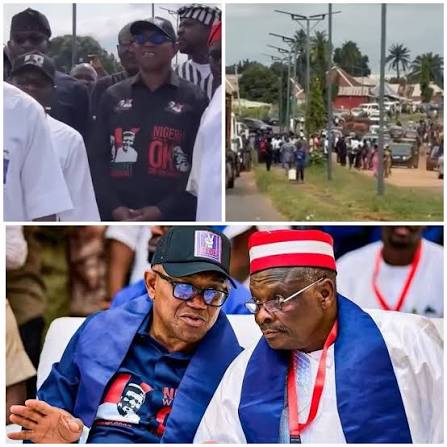
The reported obstruction of the convoy of Peter Obi, presidential candidate of the Nigeria Democratic Congress (NDC), along the Gboko Road in Makurdi has generated condemnation, counter-allegations and a renewed debate about freedom of movement, political tolerance and the responsibility of government to protect democratic rights.
Obi was in Benue, according to his account, to visit communities affected by recent deadly attacks and sympathise with bereaved families. His convoy was reportedly stopped near the Nigerian Air Force Base by a crowd carrying sticks and other objects. Videos circulating from the incident showed the convoy turning back while police officers appeared to stand between the vehicles and the crowd.
The incident has since assumed a political dimension.
Rabiu Kwankwaso, former Kano State governor and NDC vice-presidential candidate, condemned what he described as an attack on Obi’s convoy and called it another “dark day” for Nigerian democracy. He demanded that those responsible be identified and prosecuted and urged President Bola Ahmed Tinubu to caution state governors against actions capable of undermining democratic freedoms.
But the Benue State Government has rejected allegations that it sponsored or organised the youths who blocked Obi’s convoy. Governor Hyacinth Alia’s administration said it had no prior knowledge of the visit and described the allegations against it as unfounded.
That denial is important.
So too are the questions that remain unanswered.
Who mobilised the youths? Why were they there? Were they acting independently? Was there a prior security assessment of Obi’s movement? Were the police adequately prepared? And, most importantly, will there be a credible investigation capable of establishing what actually happened?
Until those questions are answered, the incident remains an allegation of political obstruction rather than a judicially established case of state-sponsored intimidation.
Yet even with that qualification, the development deserves serious democratic scrutiny.
A Constitutional Right Meets a Political Reality
At the heart of Kwankwaso’s reaction is Section 41 of the 1999 Constitution, which guarantees every Nigerian citizen the right to move freely throughout the country and reside in any part of it. The constitutional protection is not dependent on political party, popularity or whether the citizen supports the government in power.
The Constitution also protects freedom of assembly and association under Section 40 and prohibits discrimination based on, among other things, political opinion under Section 42.
These provisions are fundamental to democracy.
Democracy is not simply the periodic organisation of elections. It is the existence of a political environment in which citizens can travel, organise, speak, associate, campaign, criticise government and seek votes without being subjected to intimidation because of their political identity.
Therefore, if a citizen or political candidate is prevented from moving through a state solely because of his political affiliation, that would raise a serious constitutional question.
But there is another side to the argument.
Section 41 itself recognises that freedom of movement is not completely absolute. Restrictions may be permissible in circumstances recognised by law, particularly where public safety or criminal proceedings are legitimately involved.
That distinction matters.
A government may legitimately restrict movement where there is a genuine and demonstrable security threat. What democratic government cannot reasonably do is replace lawful security restrictions with politically motivated intimidation, mob action or unofficial roadblocks.
The difference between lawful security management and political suppression is therefore critical.
The Bigger Question: Who Controls Political Space?
The Benue incident exposes a deeper problem in Nigeria’s democratic development: the tendency for political competition to become a struggle over physical space.
Who can enter a state?
Who can address citizens?
Who can visit victims of violence?
Who can hold a political meeting?
Who can campaign in a particular community?
These should not be determined by the strength of a political party’s machinery or by the ability of supporters to mobilise crowds.
They should be determined by law.
A governor is constitutionally powerful within a state, but a state is not a political fiefdom. Likewise, opposition politicians do not have unlimited authority to disregard legitimate security procedures.
The democratic solution is therefore neither “the governor owns the state” nor “politicians can enter anywhere without security coordination.”
The solution is lawful, transparent and politically neutral administration.
The Dangerous Role of Political Thuggery
Perhaps the most disturbing element of the incident is the reported presence of youths confronting a major political figure.
Nigeria has experienced the destructive consequences of political thuggery for decades.
Young Nigerians are often mobilised by political actors during periods of heightened competition, only to become instruments in conflicts whose consequences they themselves may eventually suffer.
This is particularly troubling in a state such as Benue, which is already struggling with insecurity and the trauma of deadly attacks.
If youths can be mobilised to prevent a political opponent from visiting a community, another political group may tomorrow mobilise its own supporters to retaliate.
The result is a dangerous cycle:
provocation → mobilisation → confrontation → retaliation → political violence.
That is precisely the cycle a functioning democracy should prevent.
Obi himself argued after the incident that young people should not be used as political tools.
The lesson should extend beyond the NDC.
It should concern every political party.
The Police and the Test of Neutrality
The role of the police is perhaps the most immediate institutional question arising from the incident.
Available footage reported by several media organisations appeared to show police officers positioned between Obi’s convoy and the crowd. However, reports also indicated that the crowd appeared to move beyond the police line.
This raises an important question:
When political tensions arise, does the Nigerian security architecture possess the institutional independence and operational capacity to protect the rights of all political actors equally?
A democratic police force should not be perceived as the security arm of the party controlling government.
Its responsibility should be to protect lives, property, public order and constitutional rights—whether the person requiring protection is a ruling-party politician, opposition candidate, journalist, protester or ordinary citizen.
If the police are seen to protect one political camp while allowing another to be intimidated, public confidence in the electoral process suffers long before election day.
Why the Benue Government’s Denial Must Also Be Taken Seriously
A responsible examination of the incident must not automatically equate the presence of a hostile crowd with government sponsorship.
The Benue State Government has expressly denied involvement and said it had no prior knowledge of Obi’s visit.
That denial deserves to be tested through investigation rather than dismissed or accepted politically.
There are several questions investigators should answer:
- Who organised the crowd?
- Were the individuals known political actors?
- Who communicated with them before the incident?
- Were any government officials present?
- Did any official instruct security personnel to allow or stop the convoy?
- Were there prior communications between Obi’s team and state authorities?
- Was the visit properly communicated for security coordination?
- Did anyone finance or transport the protesters?
- Were weapons or dangerous objects used?
- What did the police command know before the convoy arrived?
These are factual questions.
They cannot be answered adequately through partisan statements on social media.
The Protocol Argument: Security or Political Gatekeeping?
The Benue Government has also raised the issue of protocol and prior notification. Reports indicate that the government said it had not been informed of Obi’s visit.
There is nothing inherently wrong with political figures coordinating movements with security authorities, particularly in a state experiencing serious insecurity.
In fact, responsible security planning requires communication.
But protocol must not become a political veto.
If notification is required for security reasons, the requirement should apply consistently to politicians across party lines.
Otherwise, administrative protocol can become a convenient instrument for selectively restricting opposition activity.
The democratic standard should therefore be:
security coordination, yes; political permission, no.
The International Community Is Watching
Kwankwaso’s appeal to diplomatic missions and election-observation organisations is significant because Nigeria’s democratic credibility is no longer judged solely within its borders.
International observers routinely assess whether political competition takes place on a reasonably level playing field.
An incident involving the obstruction of a major opposition figure therefore has significance beyond Benue.
However, international actors should also be careful.
Their role should not be to accept the allegation of one political party as established fact. Their responsibility should be to encourage Nigerian authorities to investigate impartially, protect political rights and ensure that all parties operate under the same rules.
The strongest democratic response would not be a diplomatic condemnation based solely on competing claims.
It would be an independent determination of the facts.
The 2027 Election Question
The timing makes the incident even more consequential.
Nigeria is moving toward the 2027 general elections, a period when political temperatures will inevitably rise.
What happens today can become the precedent for tomorrow.
If political actors learn that supporters can physically prevent opponents from entering communities, such behaviour could become normalised.
If governors learn that administrative authority can be interpreted as political control over opposition activities, democratic competition could gradually become narrower.
If opposition parties conclude that the security agencies cannot protect them, they may increasingly depend on their own security structures.
And once political parties begin developing competing street forces, Nigeria moves away from constitutional democracy and towards political confrontation.
That is why the Benue incident should not be treated simply as another political quarrel.
It should be treated as an early warning.
Democracy Is Tested Between Elections
One of the greatest misunderstandings about democracy is that it is tested only on election day.
It is not.
Democracy is tested when the opposition wants to enter a state controlled by the ruling party.
It is tested when an unpopular politician wants to speak.
It is tested when protesters criticise government.
It is tested when journalists investigate those in power.
It is tested when government supporters must tolerate criticism from opponents.
And it is tested when those in power have the opportunity to misuse their authority—but choose not to.
That is why the Benue incident deserves more than partisan condemnation.
It demands institutional reflection.
What Should Happen Now?
First, the Nigeria Police Force should establish the facts surrounding the incident and publicly clarify what happened.
Second, anyone found to have physically attacked or unlawfully obstructed the convoy should face the law, regardless of political affiliation.
Third, if any government official is found to have organised, funded or directed unlawful political violence, the same principle should apply.
Fourth, if Obi’s team failed to observe legitimate security protocols, that should also be established clearly and addressed through lawful administrative channels—not mob action.
Fifth, political parties must publicly discourage their supporters from using violence or intimidation against opponents.
Finally, state governments must understand that political opposition is not an act of rebellion.
An opposition politician has the right to criticise a governor.
A governor has the right to defend his administration.
A political party has the right to mobilise supporters.
But none of these rights should translate into the right to physically intimidate another Nigerian.
A Democracy Cannot Have Political No-Go Areas
The most troubling question from Benue is not whether Peter Obi was popular or unpopular among the crowd.
It is not whether the visit was political or humanitarian.
It is not even whether the Benue Government knew about the visit.
The fundamental question is simpler:
Can a Nigerian citizen be prevented from moving through Nigeria because a group of people does not want him there?
If the answer is yes, then the country has a serious democratic problem.
If the answer is no, then the institutions of state must demonstrate that principle in practice.
Nigeria’s Constitution guarantees freedom of movement, association and protection against discrimination based on political opinion.
But constitutional rights mean little if citizens can be denied those rights on the roadside by political mobs.
The real test of Nigeria’s democracy, therefore, is not whether political leaders can make powerful speeches about democracy.
It is whether an opposition candidate can travel through a state controlled by political opponents without being physically intimidated—and whether the government has the courage and institutional independence to protect that right.
The road to 2027 will be travelled long before Nigerians reach the polling booths.
And what happens on that road may tell the country—and the world—how seriously Nigeria intends to protect its democracy.