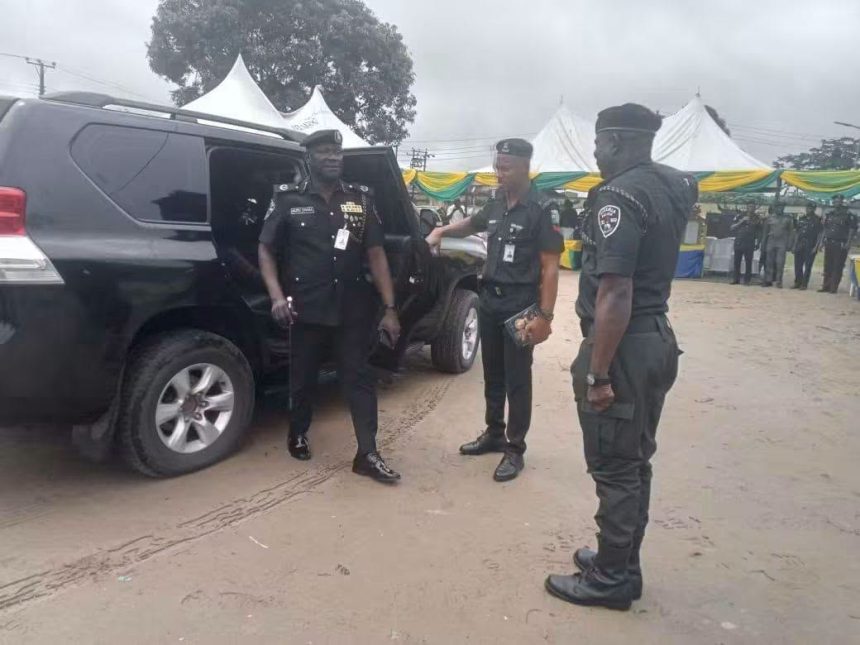
Remembering the officers and civilians who stood between vulnerable communities and violent crime
There was a period when travelling through parts of Delta State—particularly Uvwie, Udu, Warri South, Ughelli, Egbo-Uhurie, Otokutu, Agbarho and the Sapele Road axis—came with a heightened sense of anxiety.
The communities, commercial corridors and adjoining neighbourhoods were confronted by varying forms of insecurity, including armed robbery, kidnapping and other violent crimes. For residents, traders, motorists and business owners, the challenge was not simply the fear of crime; it was the uncertainty over what could happen on the road, in the neighbourhood or at the workplace.
It was an era that tested the resilience of communities—and equally placed enormous demands on the men and women of the Nigeria Police Force.
A Difficult Security Era
At the height of the restiveness, law enforcement agencies faced the difficult task of responding to criminal activities across wide and often challenging operational environments.
The geography of the affected areas presented its own complications. Major roads connected densely populated communities, industrial and commercial centres, residential neighbourhoods and rural settlements. Criminal elements could exploit the complex terrain, while police formations were required to respond rapidly to incidents and protect vulnerable locations.
Against this backdrop, police officers were expected to operate under considerable pressure.
Patrols had to be sustained. Intelligence had to be gathered. Suspects had to be identified and arrested. Victims had to be rescued. Criminal networks had to be disrupted, while officers themselves remained exposed to considerable danger.
It was within this difficult environment that several police officers distinguished themselves through operational commitment and determination.
ACP Aliyu Shaba: A Commander’s Operational Resolve
Among the officers remembered for their contributions during that period is ACP Aliyu Shaba, whose role in policing the challenging security environment remains part of the recollections of people who witnessed those difficult years.
The work of a police commander in a volatile environment extends beyond responding to individual incidents. It involves coordinating personnel, deploying resources, developing intelligence, engaging communities and making difficult operational decisions.
For officers working in such circumstances, every operation carried an element of risk.
The contribution attributed to ACP Shaba is therefore best understood within the broader efforts of the police formations and personnel who worked to contain criminality and restore public confidence.
ASP Julius Robinson and the Fight Against Criminality
Another name that continues to resonate in accounts of that period is ASP Julius Robinson, whose operational activities earned recognition among those who followed the security situation closely.
Robinson was associated with frontline policing responsibilities at a time when tackling violent crime required determination, intelligence gathering and close coordination with other security stakeholders.
His involvement, alongside that of other officers, reflected the difficult reality of policing communities where criminal activities could quickly escalate into wider threats to public safety.
For many residents, the significance of such officers was not necessarily measured by official reports or statistics. It was experienced in more personal ways—the ability to travel with greater confidence, reopen businesses, return home safely or sleep with less fear.
Beyond the Uniform: The Community’s Silent Contribution
But the story of the struggle against insecurity in these communities cannot be told solely through the actions of uniformed personnel.
Behind many successful security operations were ordinary civilians who provided information, alerted security agencies to suspicious activities and assisted investigations.
Some of these individuals operated quietly and without public recognition. In environments where criminals could identify and retaliate against informants, providing credible information was itself an act of courage.
Community intelligence can be critical to effective policing. Residents understand their neighbourhoods, know unusual movements and can identify patterns that may not immediately be apparent to outsiders.
The cooperation between responsible citizens and law enforcement therefore became an important component of the wider response to insecurity.
The Cost of Keeping Communities Safe
The public often sees the outcome of a security operation but rarely sees the risks undertaken before that outcome is achieved.
A successful intervention may mean an arrested suspect, a rescued victim, a recovered weapon or the disruption of a criminal operation. Behind such outcomes, however, are officers who spend long hours on patrol, respond to distress calls and enter potentially dangerous environments.
Some officers sustain injuries. Others work away from their families for extended periods. Many undertake responsibilities that rarely receive public recognition.
The men and women who served during Delta State’s period of heightened restiveness were therefore part of a much larger institutional effort to protect lives and property.
Their story is also a reminder that security is rarely achieved by one individual or one agency.
A Legacy That Outlived Their Posting
Many of the officers who served in these areas have since been transferred to other commands, formations and states. Some have risen through the ranks, while others have moved into different phases of their careers.
Yet geographical transfers do not necessarily erase the impact of service.
For residents who experienced the difficult years, the memories remain. The names of officers who were frequently seen on the frontline remain associated with a period when the battle against violent crime demanded unusual courage and commitment.
ACP Aliyu Shaba and ASP Julius Robinson are among those whose contributions deserve to be remembered alongside the efforts of numerous other officers whose names may not always appear in public accounts.
Remembering the Unsung Heroes
There is also a broader lesson from this chapter of Delta State’s security history.
The restoration of peace in any community is rarely the achievement of security personnel alone. It requires responsible citizens, traditional and community leaders, youth groups, information providers, government institutions and security agencies working toward a common objective.
The civilians who supplied vital information, opened their doors to investigators, assisted victims or quietly supported security operations also deserve recognition.
They may never have received medals or formal commendations, but their contributions formed part of the invisible infrastructure that helped law enforcement respond to threats.
A Tribute to Courage and Service
Today, as communities look back on that era, the memories should not be used merely to reopen old wounds. They should also serve as a reminder of how fragile peace can be—and how important responsible security partnerships remain.
The story of Uvwie, Udu, Warri South, Ughelli, Egbo-Uhurie, Otokutu, Agbarho and the Sapele Road axis is, in part, a story of communities confronted by insecurity and of people who refused to surrender their communities to fear.
It is a story of police officers who accepted difficult assignments, civilians who provided critical support and communities that continued to demand peace despite the challenges confronting them.
For those who served on the frontline, the greatest tribute may not simply be an award or public ceremony. It is the preservation of their story.
To the police officers who stood their ground during those difficult years, and to the civilians who supported them from behind the scenes, this is a tribute to courage, duty and service.
Their postings may have ended.
Their uniforms may have changed.
But for the communities they helped protect, their legacy remains.