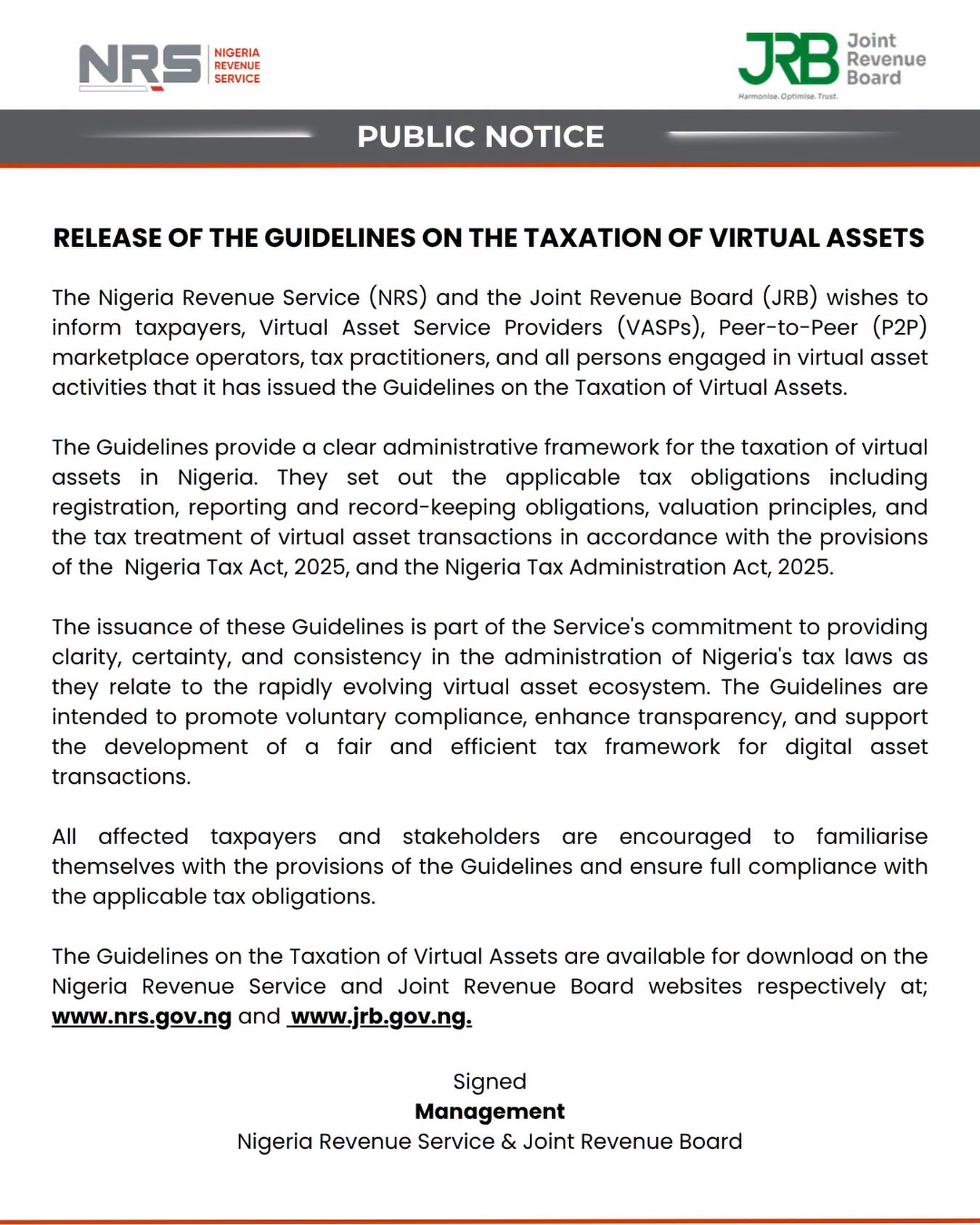
NRS, JRB issue new guidelines covering registration, reporting, valuation and record-keeping for digital asset transactions
The Federal Government has taken another major step towards bringing Nigeria’s rapidly expanding virtual asset ecosystem under a clearer tax administration framework with the release of new Guidelines on the Taxation of Virtual Assets.
The Nigeria Revenue Service (NRS) and the Joint Revenue Board (JRB) announced the issuance of the guidelines in a public notice addressed to taxpayers, Virtual Asset Service Providers (VASPs), peer-to-peer (P2P) marketplace operators, tax practitioners and others involved in virtual asset activities.
The new framework is designed to provide greater clarity and consistency in the administration of taxes arising from virtual asset transactions in Nigeria.
A Framework for the Digital Economy
According to the NRS and JRB, the guidelines establish an administrative framework covering key areas of virtual asset taxation, including registration, reporting, record-keeping, valuation principles and the tax treatment of virtual asset transactions.
The guidelines are to operate in line with the provisions of the Nigeria Tax Act, 2025, and the Nigeria Tax Administration Act, 2025.
The development comes as digital assets, including cryptocurrencies and other forms of virtual assets, continue to play a growing role in financial and commercial activities worldwide.
For Nigeria, the new guidelines represent an attempt to provide a more structured approach to an increasingly complex sector in which transactions can take place across conventional financial institutions, digital platforms and peer-to-peer marketplaces.
VASPs and P2P Operators in Focus
The notice specifically identifies Virtual Asset Service Providers and peer-to-peer marketplace operators among the stakeholders expected to familiarise themselves with the new requirements.
The inclusion of P2P operators is particularly significant given the role of peer-to-peer transactions in Nigeria’s digital asset market.
Under the new framework, affected businesses and individuals are expected to understand their applicable tax obligations and maintain appropriate records to support compliance and reporting.
Government Seeks Greater Transparency
The revenue authorities said the issuance of the guidelines forms part of their commitment to providing clarity, certainty and consistency in the administration of Nigeria’s tax laws as the virtual asset ecosystem evolves.
The framework is also intended to encourage voluntary compliance, improve transparency and support what the authorities describe as a fair and efficient tax system for digital asset transactions.
Rather than treating virtual assets as an area outside the conventional tax system, the guidelines establish administrative mechanisms for determining how existing tax obligations apply to activities involving such assets.
What Taxpayers Need to Know
The NRS and JRB have urged all affected taxpayers and stakeholders to study the guidelines and ensure compliance with applicable tax obligations.
For individuals and businesses participating in virtual asset activities, the new framework places greater importance on understanding applicable registration and reporting requirements, maintaining transaction records and applying the prescribed valuation and tax treatment.
The development also signals that virtual asset activities are receiving increasing attention within Nigeria’s broader tax administration and regulatory architecture.
Part of Nigeria’s Wider Tax Reform
The virtual asset guidelines form part of the wider implementation of Nigeria’s recently enacted tax reform framework.
By specifically addressing virtual assets, the revenue authorities are seeking to ensure that the country’s tax system keeps pace with technological developments and new forms of economic activity.
The challenge ahead will be balancing effective revenue collection with the need to maintain an environment that allows Nigeria’s digital economy and financial technology sector to continue developing.
The Guidelines on the Taxation of Virtual Assets are available for download through the official websites of the Nigeria Revenue Service and Joint Revenue Board, as indicated in the public notice.
FRESH FACTS TAKE
The release of the virtual asset taxation guidelines marks an important development in Nigeria’s evolving digital economy. For cryptocurrency users, investors, traders, VASPs and P2P operators, the message from the revenue authorities is increasingly clear: virtual asset activity now sits firmly within the country’s emerging tax compliance framework.